G l o b a l E n v i r o n m e n t F a c i l i t y
GEF/C.31/10
May 11, 2007
GEF Council
June 12-15, 2007
Agenda Item 16
FOCAL AREA STRATEGIES
AND STRATEGIC PROGRAMMING FOR GEF-4
Recommended Council Decision
The Council reviewed document GEF/C.31/10, Focal Area Strategies and Strategic
Programming for GEF-4, and approves the strategies as a basis for guiding the programming
of resources during GEF-4. The Council agrees that the structure of long-term strategic
objectives and strategic programs for a replenishment period should replace the previous
operational programs and strategic priorities.
The Council requests the Secretariat, in collaboration with the GEF agencies, to
operationalize the strategic programs and objectives in alignment with the ongoing
development and implementation of the results-based management framework.
The Council requests the Secretariat to initiate work on the development of strategic
objectives and programs for GEF-5 in 2008 with a view to presenting proposed strategic
programming for GEF-5 to the Council at its first meeting in 2009.
EXECUTIVE SUMMARY
1.
Revised strategies and proposed strategic programming for GEF-4 are presented for the
six focal areas of the GEF and for two cross-cutting areas (sustainable forest management and
sound chemicals management).
2.
The revised strategy papers presented as annexes to this document are the result of a
consultative process involving external advisory groups and contributions from Council
Members, Convention secretariats, GEF agencies, STAP, and other GEF partners.
3.
The proposed long-term strategic objectives for the focal areas are consistent with the
focal area strategies prepared for the negotiations for the fourth replenishment of the GEF Trust
Fund in 2005 and presented to Council in December 2006. Equivalent strategic objectives have
been defined for the two cross-cutting areas. The expected long-term impacts associated with
each strategic objective have been explicitly stated to emphasize the GEF's drive for results.
4.
As a step towards a more programmatic approach, strategic programs have been
described in support of the long term strategic objectives. These strategic programs define the
strategic focus of the GEF during the fourth replenishment period. Expected outcomes associated
with each strategic program are explicitly stated. These expected outcomes represent the
collective results from the interventions supported during GEF-4 under each strategic program,
although these results may only materialize later.
5.
The structure of long-term strategic objectives and strategic program that are redefined
for every replenishment period is suggested to replace the previous structure of operational
programs and strategic priorities. The proposed structure balances continuity and flexibility and
supports the emphasis on results.
6.
Indicators have been identified for each expected impact (at the long-term strategic
objective level) and for each expected outcome (at the strategic program level). These indicators
will enable a systematic monitoring of the actual achievement of the expected impacts and
outcomes. The indicator framework will be further developed in connection with the emerging
results-based management framework for the GEF.
i
Table of Contents
Background..................................................................................................................................... 1
The process for revision of the focal area strategies................................................................... 1
Moving towards a programmatic focus for GEF-4..................................................................... 2
A common results framework for the focal area strategies ........................................................ 6
Cross-cutting issues .................................................................................................................... 6
Recommendations for follow-up ................................................................................................ 8
Annex 1. Biodiversity focal area strategy and strategic programming for GEF-4 ....................... 9
Annex 2. Climate change focal area strategy and strategic programming for GEF-4................ 26
Annex 3. Land degradation focal area strategy and strategic programming for GEF-4............. 38
Annex 4. International waters focal area strategy and strategic programming for GEF-4......... 51
Annex 5. Persistent organic pollutants focal area strategy and strategic programming
for GEF-4 .................................................................................................................... 64
Annex 6. Ozone layer depletion focal area strategy and strategic programming for GEF-4 ..... 76
Annex 7. Sustainable forest management framework strategy for GEF-4 ................................. 81
Annex 8. Sound chemicals management framework strategy and strategic programming
for GEF-4 .................................................................................................................... 90
BACKGROUND
1.
The policy recommendations for the fourth replenishment of the GEF Trust Fund
requested the Secretariat to review and revise as necessary the six focal area strategies, taking
into account cross-cutting issues of sustainable forest management and sound chemicals
management. The revised strategies were also to provide the basis for a simplified approach to
the GEF's operational programs and strategic objectives for the fourth replenishment of the GEF
Trust Fund.
2.
Working drafts of focal area strategies and two additional draft papers addressing the
cross-cutting issues of sustainable forest management and sound chemicals management were
presented to Council in December 2006. These papers were based on the focal area strategies
prepared at the end of 2005 in preparation for the negotiations for the fourth replenishment of the
GEF Trust Fund.
3.
Council reviewed the working drafts and requested the Secretariat to continue its work to
revise the focal area strategies along the following lines:
(a)
the revised focal area strategies should focus on global outcomes and impacts of
future GEF interventions and should provide a basis for the development of
measurable results indicators;
(b)
the focal area strategies should be focused on a definite set of priority issues
reflecting major global environmental concern;
(c)
cross-cutting issues should to be more systematically identified, analyzed and
integrated in the focal area strategies; and
(d)
there is a need for more harmonized and integrated approaches to capacity
building, knowledge management and learning, and engagement of the private
sector across the focal areas.
4.
In December 2006, the CEO presented to Council a five point sustainability compact to
increase the efficiency and impact of the GEF. A central element of this proposed reform
package was to move away from the previous single-project interventions towards a more
programmatic focus for the GEF. The purpose of this move is two-fold: to focus the limited
funding resources of GEF-4 on a set of priority issues of global environmental concern, and to
achieve higher impact and visibility of the GEF by linking project interventions together in a
programmatic context.
THE PROCESS FOR REVISION OF THE FOCAL AREA STRATEGIES
5.
In order to ensure a broad and consultative process, the CEO established five Technical
Advisory Groups (TAGs) on biodiversity, climate change, sustainable land management,
international waters, and sound chemicals management, and a Strategy Advisory Group (SAG)
as an overarching coordinating group.
1
6.
Each TAG was composed of three external experts, selected among nominations by the
Council Members, a representative from the secretariat of the relevant Convention1, a member of
STAP, and a member from the GEF Secretariat who served as technical secretary and convener
of the TAG. The TAGs typically met weekly by teleconference from January to April 2007. In
addition, a two-day joint TAGs meeting was organized in Washington, D.C., in March 2007 to
allow for more in-depth discussion within the TAGs as well as discussions between the TAGs on
cross-cutting issues. This meeting was also used to convene an ad hoc working group on
Sustainable Forest Management with representatives from the TAGs on biodiversity, land
degradation and climate change as well as two additional external experts.
7.
The SAG was composed of one representative from each of the five TAGs, the Chair of
STAP, and four external experts. Meetings of the SAG, convened and chaired by the CEO, were
organized in Washington, D.C., in February and April 2007, to review drafts papers presented by
the TAGs and to discuss cross-cutting issues. The GEF agencies and the GEF Evaluation Office
were invited to attend the SAG meetings as observers.
8.
Working drafts of the focal area strategies and minutes from the meetings of the TAGs
and the SAG were posted on the GEF website (under "Policies") throughout the process along
with the terms of reference and membership of the advisory groups. Comments on the working
drafts received from the GEF partners throughout the process were posted on the website. In
particular, Council Members and were invited to provide comments on the draft strategy papers
presented to the SAG in April 2007.
9.
The product of this collective effort is presented to Council under the responsibility of the
GEF Secretariat in the attached revised strategy papers for each of the six GEF focal areas plus
for the cross-cutting areas of sustainable forest management and sound chemicals management.
The Secretariat would like to thank all participants in this process, in particular the members of
the TAGs, for their invaluable contributions and advice, based on which the Secretariat has
prepared the final draft focal area strategy papers for consideration and approval by Council.
MOVING TOWARDS A PROGRAMMATIC FOCUS FOR GEF-4
10.
Each of the attached strategy papers contains:
(a)
a long-term strategy consistent with the working drafts presented to Council in
December 2006 and with programming for the fourth replenishment of the GEF
Trust Fund, adjusted in accordance with the guidance provided by Council
Members; and
(b)
proposed strategic programming for GEF-4, as further described below.
11.
The focal area strategy papers define a set of strategic programs for GEF-4 within each
focal area that would support the achievement of the long-term strategic objectives, which have
been revised from the focal are strategies presented to Council in December 2006, based on the
1 The TAG on Chemicals included an additional member from the Multilateral Fund for the Montreal Protocol.
2
comments from Council. The strategic programs have been selected and defined in view of their
importance, urgency and cost-effectiveness from a global environment perspective, as well as the
priorities identified by countries, especially in the context of the implementation of the RAF, as
well as overall guidance from the Multilateral Environmental Agreements. The strategic
programs provide an intermediate link between the project level and the overall objectives of the
GEF within the focal areas.
12.
The strategic objectives and strategic programs for the six focal areas and for the cross-
cutting areas of sustainable forest management and sound chemicals management are
summarized in the table below. The strategic programs all represent a focusing in relation to the
strategic objectives, although there is a slight difference among the focal areas in how one level
relates to the other. In the biodiversity focal area, a number of strategic programs are defined for
each strategic objective, whereas for land degradation and international waters, the set of
strategic programs collectively supports the strategic objectives. For climate change, the strategic
objectives were already relatively concrete, and the strategic programs represent a selection of
those areas that will be pursued in GEF-4. For sustainable forest management and sound
chemicals management, the listed strategic programs present ways by which these two cross-
cutting areas will be supported by interventions in the six focal areas during GEF-4 and by
additional strategic programs cutting across the focal areas.
13.
The Secretariat proposes that the structure of strategic objectives and strategic programs
will replace the previous structure of GEF operational programs (OPs) and strategic priorities.
The proposed structure of strategic objectives covering the long-term perspective versus strategic
programs covering the possible achievements from interventions over a replenishment period is
more readily aligned with the emerging results-based management framework, as further
described below.
3
Table 1: Strategic objectives and strategic programs
Strategic Long-term Objectives
Strategic Programs for GEF-4
BIODIVERSITY
1: To catalyze sustainability of protected area
1. Sustainable financing of PA systems at the national level
(PA) systems
2. Increasing representation of effectively managed marine PA areas
in PA systems
3. Strengthening terrestrial PA networks
2: To mainstream biodiversity in production
4. Strengthening the policy and regulatory framework for
landscapes/seascapes and sectors
mainstreaming biodiversity
5. Fostering markets for biodiversity goods and services
3: To safeguard biodiversity
6. Building capacity for the implementation of the Cartagena
Protocol on Biosafety
7. Prevention, control and management of invasive alien species
4: To build capacity on access and benefit sharing 8. Building capacity on access and benefit sharing
CLIMATE CHANGE
1: To promote energy-efficient technologies and
1. Promoting energy efficiency in residential and commercial
practices in the appliance and building sectors
buildings
2: To promote energy-efficient technologies and
2. Promoting energy efficiency in the industrial sector
practices in industrial production and
manufacturing processes
3: To improve the efficiency and performance of
Strategic objective not pursued directly in GEF-4
existing power plants
4: To promote on-grid renewable energy
3. Promoting market approaches for renewable energy
5: To promote the use of renewable energy for the Strategic objective not pursued directly in GEF-4
provision of rural energy services (off-grid)
6: To support new low-GHG emitting energy
4. Promoting sustainable energy production from biomass
technologies
7: To facilitate market transformation for
5. Promoting sustainable innovative systems for urban transport
sustainable mobility in urban areas leading to
reduced GHG emissions
8: To support pilot and demonstration projects for Reference is made to the SPA, SCCF and LDCF, and to the principle of GEF-wide
adaptation to climate change
climate proofing described in Annex 2
LAND DEGRADATION
1: To develop an enabling environment that will
1. Supporting sustainable agriculture and rangeland management
place Sustainable Land Management (SLM) in
2. Supporting sustainable forest management in production
the mainstream of development policy and
landscapes
practices at the regional, national and local
levels
3. Investing in innovative approaches in SLM
2: To upscale SLM investments that generate
mutual benefits for the global environment and
local livelihoods
4
INTERNATIONAL WATERS
1: To foster international, multi-state cooperation
1. Restoring and sustaining coastal and marine fish stocks and
on priority transboundary water concerns
associated biological diversity
2: To catalyze transboundary action addressing
2. Reducing nutrient over-enrichment and oxygen depletion from
water concerns
land-based pollution of coastal waters in LMEs consistent with
the GPA
3. Balancing overuse and conflicting uses of water resources in
transboundary surface and groundwater basins
4. Adapting to melting ice in high-altitude basins and polar systems
POPs
1: To reduce and eliminate production, use and
1. Strengthening capacity for NIP (National Implementation Plan)
releases of POPs
development and implementation
2. Partnering in investments for NIP implementation
3. Generating and disseminating knowledge to address future
challenges in implementing the Stockholm Convention
ODS
1: To phase out production and consumption of
1. Phasing out HCFC and strengthening of capacities and
ODS
institutions
SUSTAINABLE FOREST MANAGEMENT
1: To protect globally significant forest
1. Sustainable financing of protected area systems at national level
biodiversity
(same as BD#1)
2: To promote sustainable management and use of 2. Strengthening terrestrial protected area networks (same as BD#3)
forest resources
3. New: Forest conservation as a means to protect carbon stocks and
avoid CO2 emissions (cross-cutting BD/CC/LD)
4. Strengthening the policy and regulatory framework for
mainstreaming biodiversity (same as BD#4)
5. Fostering markets for biodiversity goods and services (same as
BD#5)
6. New: Promoting sustainable energy production from biomass
(cross-cutting CC#4/BD/LD)
7. Supporting sustainable forest management in production
landscapes (same as LD#2)
SOUND CHEMICALS MANGEMENT
1: To promote sound management of chemicals
1. Integrating sound chemicals management in GEF projects
for the protection of human health and the
2. Articulating the chemicals-related interventions supported by the
global environment
GEF within countries' frameworks for chemicals management
5
A COMMON RESULTS FRAMEWORK FOR THE FOCAL AREA STRATEGIES
14.
A major effort by the TAGs has been to align the focal area strategies with the emerging
results-based management (RBM) framework for the GEF, in order to direct the strategies
towards tangible global environmental benefits and to enable adequate reporting on the
implementation of the strategies. The RBM framework presented to Council as document
GEF/C.31/11 operates at three levels (institution level, focal area programmatic level, and
project level) in keeping with GEF's Monitoring and Evaluation Policy. The TAGs have
primarily contributed to the content of the RBM framework at the focal area programmatic level.
15.
The RBM framework proposed for the GEF is based on the OECD/DAC Glossary of Key
Terms in Evaluation and Results-based Management (2002) that defines a hierarchy of result
terms from higher order goals, through long-term impacts and medium-term outcomes, to the
immediate outputs of interventions. In principle, the entire hierarchy of result terms could be
applied to each of the levels of the RBM framework, however, the experience with such a
comprehensive approach is that it inevitably leads to redundancy and unnecessary complexity.
Instead, a pragmatic simplified approach has been followed, where long-term expected impacts
on the global environment are assigned to each of the strategic objectives, and intermediate
expected outcomes are assigned to each of the strategic programs. The expected impacts and
outcomes at the programmatic level are supported by the results at the project level. Further
description of the RBM framework and its operational aspects is given in document
GEF/C.31/11.
16.
The TAGs have proposed measurable indicators at the outcome level for each strategic
program and at the impact level for each strategic objective. The advisory groups have sought to
select appropriate, simple and useful indicators, but have realized that this is not a
straightforward task, given the complexity and intricacy of GEF's mission. Indicator
development therefore remains an area of work in progress. It should also be emphasized that the
monitoring and reporting of measurable indicators can only provide partial evidence and must be
supplemented by evaluative judgment in order to assess the achievement of expected outcomes
and impacts.
17.
It is considered premature at this stage to set specific targets for the expected outcomes
and impacts. Setting specific targets that are challenging, yet realistic, requires a thorough
analysis of a) the feasibility of the proposed interventions, b) the expected financing from GEF
and from co-finance and its geographical distribution, c) the actual baseline in this geographical
context, and d) interaction with other ongoing and planned interventions.
CROSS-CUTTING ISSUES
18.
Apart from developing revised strategies and strategic programming for GEF's six focal
areas, a number of cross-cutting issues were also addressed during this process.
19.
Sustainable forest management (SFM) was identified as a cross-cutting area where a
separate strategy was needed. A strategic approach paper on SFM has previously been presented
to Council (ref. GEF/C.27/14). An ad hoc working group on sustainable forest management was
6
established with representatives from the TAGs on biodiversity, land degradation and climate
change as well as two additional external experts. The working group produced a framework
strategy for SFM (attached as Annex 7) that provides a coherent description of how the proposed
strategic programs in the three focal areas (BD, LD and CC) will jointly contribute to SFM in
GEF-4. The framework strategy also proposes two additional multi-focal area strategic programs
entitled "Forest Conservation as a Means to Protect Carbon Stocks and Avoid CO2 Emissions"
and "Promoting Sustainable Energy Production from Biomass."
20.
Adaptation to climate change is directly addressed as a strategic objective under the
climate change focal area and is increasingly recognized as a cross-cutting issue by the other
focal areas. A principle of `climate proofing' will be followed across the entire GEF-4 portfolio.
For example, the biodiversity strategy paper emphasizes the need for capacity building to design
resilient protected area systems that can continue to achieving conservation objectives in the face
of anticipated climate change and variability.
21.
GEF support to sound chemicals management is described in a separate strategy paper
(attached as Annex 8) produced by the TAG on chemicals in consultation with the other TAGs.
Sound chemicals management is directly addressed in the focal areas of POPs and ODS, and is
increasingly recognized as a cross-cutting issue by the other focal areas. A principle of
`chemicals proofing' will be pursued in GEF-4 across the focal areas, where relevant.
22.
Other inter-linkages between the focal areas are reflected in the respective focal area
strategy papers. Thus, the strategic program on marine protected areas in biodiversity is linked to
the strategic program on marine fish stocks and associated biodiversity in international waters;
the strategic objective of mainstreaming biodiversity in biodiversity, and the strategic program
on balancing uses of water resources in international waters are both linked to the strategic
program on sustainable agriculture and rangeland management in land degradation; the strategic
program on sustainable energy from biomass in climate change is linked broadly to the focal
areas of biodiversity and land degradation.
23.
A GEF Strategy to Enhance Engagement with the Private Sector was presented to
Council in June 2006 and has been further developed with an operational road map for
implementation of a GEF Public/Private Sector Partnership Fund (PPP) to support a strategic
investment program in competitive technological and financial solutions to global environmental
concerns (ref. GEF/C.31/9). Sectoral platforms related to the focal area strategic programs will
be developed and implemented under the PPP. Initial consultations have identified possible
platforms within biofuels, membrane bioreactors for wastewater treatment in coastal areas and
clean energy promoting investment in renewable energy and energy efficiency. These platforms
are directly linked to and will support specific strategic programs in the focal area strategies.
24.
A cross-cutting goal for the GEF is to ensure that capacity is left behind in countries
following project completion - capacity that can be identified and measured using outcome
indicators. This will be done by embedding capacity building elements in a coordinated manner
in GEF projects by promoting programmatic approaches, where demanded. This would include
activities that achieve better defined policy targets, data collection and indicator tracking
systems, and use of quantitative metrics and analysis in policy formation and evaluation. This is
7
in recognition that achieving good environmental performance depends overall upon the level of
development and good governance. The impact of this exercise would be strengthened
institutional capacity that ensures continuation of global environmental benefit generation.
25.
Knowledge management, learning and targeted research are unevenly addressed in the
focal area strategy papers. A more comprehensive approach to targeted research is needed to
strengthen innovative approaches and to support the development of future strategic programs.
Knowledge management and systematic learning are equally important to ensure that the insights
generated through project interventions add value internally and externally.
RECOMMENDATIONS FOR FOLLOW-UP
26.
The GEF Secretariat finds that the strategy papers presented to Council in the document
represent a significant step towards greater strategic focus and increased impact of GEF's
interventions during GEF-4, but also recognizes that there are several areas where there is still
scope for further development.
27.
There is a need for further refinement of the indicators and to define baselines and targets
related to these indicators. This will feed into the ongoing development of a results-based
management framework for the GEF.
28.
It is proposed that the development of a strategic framework for GEF-5 is given more
time and completed well before the replenishment process for GEF-5, so that the revised focal
area strategies and proposed strategic programming for GEF-5 can provide a basis for the
replenishment negotiations. This implies that the strategy process for GEF-5 should start towards
the end of 2008 and be concluded by mid-2009.
8
ANNEX 1. BIODIVERSITY FOCAL AREA STRATEGY
AND STRATEGIC PROGRAMMING FOR GEF-4
I. BACKGROUND
1.
The Millennium Ecosystem Assessment identified the most important direct drivers of
biodiversity loss and degradation of ecosystem goods and services as habitat change, climate
change, invasive alien species, overexploitation, and pollution.2 These drivers are influenced by
a series of indirect drivers of change including demographics, global economic trends,
governance, institutions and legal frameworks, science and technology, and cultural and
religious values. The biodiversity strategy in GEF-4 addresses a subset of the direct and indirect
drivers of biodiversity loss and focuses on the highest leverage opportunities for the GEF to
contribute to sustainable biodiversity conservation.
2.
The goal of GEF's biodiversity program is the conservation and sustainable use of
biodiversity, the maintenance of the ecosystem goods and services that biodiversity provides to
society, and the fair and equitable sharing of the benefits arising out of the utilization of genetic
resources. To achieve this goal the strategy encompasses four complementary and mutually
reinforcing objectives: a) improving the sustainability of protected area systems, the most
predominant and dedicated land-use globally for biodiversity conservation; b) mainstreaming
biodiversity conservation and sustainable use into production sectors that impact biodiversity; c)
safeguarding biodiversity through: i) building country capacity to implement the Cartagena
Protocol on Biosafety (CPB), and ii) prevention, control and management of invasive alien
species; and d) capacity building to support the implementation of the Bonn Guidelines on
Access to Genetic Resources and Benefit-sharing.3 Underpinning these responses, GEF will
support institutional capacity building and the development of the appropriate policy frameworks
to ensure sustainable biodiversity conservation. As a whole, the strategy encompasses a range of
interventions that respond to key drivers of biodiversity loss as presented in Table One below.
3.
The strategy is consistent with the integrated approaches to biodiversity conservation and
sustainable use promoted by the ecosystem approach, the primary framework for action under
the Convention on Biological Diversity (CBD)4. Together, these strategic objectives will make a
substantial contribution to implementing most of the Millennium Development Goals,
particularly environmental sustainability and poverty reduction, while meeting the priorities
identified by the COP of the CBD. In addition, GEF support to policy framework development
and strengthening institutions should result in favorable changes in country performance as
measured by the RAF.
2 Millennium Ecosystem Assessment 2005, Ecosystems and Human Well-being: Synthesis, Island Press,
Washington DC.
3 Decision CBD COP VII/20.
4 Decision CBD COP V/6.
9
Table 1. Responses to the Key Drivers of Biodiversity Loss
GEF Response Options: Strategic Objectives
Drivers of Biodiversity Loss
(Strategic Programs)
Habitat
Over-
Invasive
Change
exploitation Alien Species
Underlying Driver: Policy and legal
framework, institutions and governance
Sustainable protected area systems (sustainable financing,
consolidating marine & terrestrial protected area networks)
Mainstreaming biodiversity (strengthening the policy and
regulatory framework, fostering markets for ecosystem goods and
services)
Safeguarding biodiversity (capacity building in biosafety;
prevention, control & management of invasive alien species)
Access and benefit sharing (capacity building on access and
benefit sharing)
II. STRATEGIC FOCUS IN GEF-4
4.
Strategic Objective One, "To Catalyze Sustainability of Protected Area Systems,"
focuses on improving the sustainability of the protected area system. Support in GEF-4 will be
characterized by a sharper focus on improving financial sustainability and enhancing ecosystem
representation of protected of area systems. Projects supporting individual protected areas will
need to clearly demonstrate their contribution to the sustainability of the protected area system.
5.
Strategic Objective Two, "To Mainstream Biodiversity Conservation in Production
Landscapes/Seascapes and Sectors," will support country efforts to integrate biodiversity
considerations into those sectors that fall outside the environment sector. During GEF-4, a two-
pronged approach will be implemented that focuses on strengthening the policy and regulatory
framework necessary for mainstreaming to take place while fostering markets for biodiversity
goods and services. Taken together, both activities will help create incentives to change
production practices and increase biodiversity mainstreaming. GEF will not provide direct
support to adapting production practices to better protect biodiversity to avoid subsidizing the
operating costs of enterprises.
6.
In the December 2006 version of the strategy submitted to Council, Strategic Objective
Three was geared solely to developing country capacity to implement the Cartagena Protocol on
Biosafety (CPB). A revision has been made to this strategic objective and it is now titled "To
Safeguard Biodiversity". Capacity building in biosafety to help countries meet their obligations
under the CPB as was agreed at the December, 2006 Council meeting will be provided through
one strategic program. In addition, a separate strategic program will support integrated
approaches to prevent, control and manage invasive alien species.
7.
In the December 2006 version of the strategy submitted to Council, Strategic Objective
Four was entitled "Generation, Dissemination, and Uptake of Good Practices for Addressing
Current and Emerging Biodiversity Issues". This objective has been reduced in scope and is
10
now titled "To Build Capacity on Access and Benefit Sharing," which will be supported through
one strategic program. Stand-alone projects to synthesize "good practices" in biodiversity
conservation will no longer be funded, as these projects have not added measurable value to the
overall biodiversity portfolio during GEF-3.
A.
Strategic Objective 1: To Catalyze Sustainability of Protected Area Systems
8.
The GEF defines a sustainable protected area system as one that possesses the following
characteristics: a) sufficient and predictable revenue available to support protected area
management costs; b) the system includes coverage of ecologically viable representative samples
of ecosystems; and c) adequate individual, institutional and systemic capacity is in place to
manage protected areas such that they achieve their management objectives. GEF will support
comprehensive interventions that address these three aspects of protected area management in
order to catalyze the long-term sustainability of the system.
9.
The focus at the systems level will include integrating protected area management within
the management of the broader landscape and seascape. This approach acknowledges the
important contributions made to biodiversity conservation and sustainable use by biological
corridors and enhanced connectivity between protected areas while addressing the need to
manage external threats. In this way, protected areas can better fulfill their fundamental
conservation objective while contributing to poverty alleviation in rural areas.
10.
The strategy identifies capacity building opportunities to help design resilient protected
area systems that can continue to achieve their conservation objectives in the face of anticipated
climate change. This will provide a degree of insurance for GEF's investments and contribute to
long-term protected area sustainability. However, although many protected area managers
recognize the need to incorporate climate change scenarios within protected area system design,
the scientific understanding and basis for doing so is largely undeveloped. The GEF will support
adaptation components through the climate change focal area in all projects, when needed.
11.
GEF-4 support to catalyzing sustainable protected area systems will be channeled
through three strategic programs: Sustainable Financing of Protected Area Systems at the
National Level; Increasing Representation of Effectively Managed National Marine Protected
Area Networks in Protected Area Systems; and Strengthening Terrestrial Protected Area
Networks.
Strategic Program 1: Sustainable Financing of Protected Area Systems at the National
Level
12.
Restricted budgets and public sector reforms in many countries have resulted in the rapid
decline of single-source income from the national budget to support protected area management.
Thus, new financing strategies for protected area systems are more critical than ever.
Furthermore, protected area agencies and administrations are often ill equipped to respond to the
commercial opportunities that protected areas provide through consumptive and non-
consumptive uses of biodiversity.
11
13.
Financial sustainability is achieved when a protected area system is able to secure
sufficient and predictable levels of resources over the long term to meet its total costs. Through
this strategic program, GEF will support comprehensive, system-level financing solutions and
help build the capacity required to achieve financial sustainability. This will require
interventions that support the development of: a) appropriate policies and laws to allow protected
areas to manage the entire revenue stream from generation of income to investment; b) business
plans that include multiple funding sources and have a long-term perspective that matches
expenditure to revenue; c) agencies responsible for managing protected areas with sufficient
capacity to manage protected areas based on sound principles of business planning as well as
conservation biology principles; and d) full recognition of the support to protected area
conservation and management made by communities living in, and near, protected areas.
14.
GEF-supported interventions will use a variety of tools and revenue mechanisms that are
responsive to the specific country situation (conservation trust funds, systems of payments for
environmental services, easements, debt-for-nature swaps, and other mechanisms) drawing on
accepted good practice developed by GEF and others.5 GEF will also support policy reform
and/or incentives to catalyze engagement of the private sector and other stakeholders to attain
improved financial sustainability of protected areas. Individual sites may be funded through this
strategic program but only if they demonstrate replicable innovations in protected area
management (e.g., revenue generation schemes, co-management, etc.) that will increase the
efficiency of the protected area system to meet its management objectives, thereby contributing
to financial sustainability.
Strategic Program 2: Increasing Representation of Effectively Managed Marine Protected
Areas in Protected Area Systems
15.
Historically, the GEF has invested in the conservation of terrestrial ecosystems by a
factor of 3:1 when compared with support provided to marine and freshwater ecosystem
conservation. As a result of this investment, GEF has been recognized for its substantive
contribution to the global achievement of the 10% target of the world's land area under
protection.6 During GEF-4, GEF will seek to play an equally catalytic role in increasing
representation of marine ecosystems within national protected area systems.
16.
The GEF will encourage country-level efforts to address the marine ecosystem coverage
gap within national level systems. GEF will support the creation and management of national
coastal and marine protected area networks (nearshore), including no-take zones, to conserve
marine biodiversity, enhance long-term fisheries management, contribute to local livelihoods,
help hedge against natural disasters, and mitigate the effects of global climate change.
17.
Through the international waters focal area, the GEF has helped establish management
and policy frameworks in large marine ecosystems that provide the necessary foundation for
marine protected areas to be successful. During GEF-4, the international waters focal area
5 GEF Experience with Conservation Trust Funds (GEF Evaluation Report # 1-99 ).
(http://www.thegef.org/MonitoringandEvaluation/MEPublications/MEPArchive/Conservation_TF-Evak__1-
99.pdf).
6 OPS3: Progressing Toward Environmental Results, Third Overall Performance Study of the GEF.
12
strategic program on "Restoring and Sustaining Coastal and Marine Fishstocks and Associated
Biodiversity" will also complement the biodiversity investment in marine protected areas. When
financially and operationally feasible, GEF will support investments in marine protected areas,
particularly in those countries where national-level interventions in fisheries management have
looked at financial incentives to influence fisheries management, such as changes in subsidies,
taxation of vessels, etc. This will help ensure that marine biodiversity investments are taking
place within the supportive regulatory framework required for marine protected areas to achieve
their management objectives.
Strategic Program 3: Strengthening Terrestrial Protected Area Networks
18.
The objective of this strategic program is to ensure better terrestrial ecosystem
representation in protected area systems through filling ecosystem coverage gaps (including
freshwater, wetlands, temperate and tropical grasslands, Mediterranean ecosystems, lowland
tropical forests, etc.). Also relevant are coverage gaps related to habitat for landraces, crop wild
relatives of species of economic importance, and ecosystem services. Interventions that seek to
address an ecosystem coverage gap will need to demonstrate that human and financial resources
are reallocated to the additional protected area and that this reallocation results in a management
effort that is consistent with the management levels found throughout the protected area system.
This will help ensure the sustainability of the system from a management perspective.
19.
GEF will also support targeted research to empirically estimate changes in land use or
resource extraction patterns that result from establishing protective status on terrestrial
ecosystems. The purpose of this research will be to improve understanding of the effectiveness
of different forms of protected areas which will inform decisions within GEF projects on the
siting, establishment and design of terrestrial protected area networks. Through establishing the
evidence base upon which these kinds of management decisions can be made, GEF will be better
positioned to support protected area investments that will achieve their conservation objectives.
B.
Strategic Objective 2: To Mainstream Biodiversity in Production
Landscapes/Seascapes and Sectors
20.
Over the long term, viable biodiversity conservation will require the sustainable
management of a landscape and seascape mosaic that includes protected areas and a variety of
other land and resource uses, especially as human pressure on land continues to increase.
Therefore, parallel to improving the sustainability of protected area systems, GEF will help
integrate the conservation and sustainable use of biodiversity into the sectors of the economy that
strongly impact biodiversity outside of protected areas--often referred to as "mainstreaming".7
As noted by the Millennium Ecosystem Assessment, the sustainable use of biodiversity will only
be achieved once biodiversity is mainstreamed within production sectors. Through this strategic
7 The strategy makes use of the results of the STAP Workshop held in Cape Town, South Africa in 2004 on the
subject of mainstreaming, where the participants defined the objective of mainstreaming as "to integrate the goals of
conservation and sustainable use of biological resources into those sectors, development models, policies, and
programs, and therefore all human behavior". Mainstreaming Biodiversity in Production Landscapes. Caroline
Petersen, Brian Huntley, Global Environment Facility, Working Paper 20, November 2005.
13
objective, substantive contributions to the goal of the land degradation focal area will be realized
through the expansion of sustainably managed landscapes.
21.
The GEF will support efforts to remove the barriers that prevent public and private sector
actors from mainstreaming biodiversity through two strategic programs. The first strategic
program, "Strengthening the Policy and Regulatory Framework for Mainstreaming
Biodiversity," will support the development of the policy and regulatory frameworks that
promote and reward mainstreaming and build the necessary institutional capacity. The second
strategic program, "Fostering Markets for Biodiversity Goods and Services," seeks to catalyze
markets for biodiversity goods and services and promote voluntary environmental certification to
generate biodiversity gains through market mechanisms.
Strategic Program 4: Strengthening the Policy and Regulatory Framework for
Mainstreaming Biodiversity
22.
The incorporation of biodiversity conservation into broader policy and regulatory
frameworks is not taking place in many GEF-eligible countries due to a number of constraining
factors, some common to conservation generally (poor governance, weak capacity, lack of
scientific knowledge) and others specific to the challenge of mainstreaming biodiversity into
productive sectors (lack of incentives, inadequate valuation data on biodiversity, etc.).
23.
When mainstreaming yields substantial social or private benefits and thus provides
incentives for public and private actors to effect policy changes, these actors may be unaware
that they have such incentives. In these circumstances, providing information on the value of
biodiversity and its contribution to national development or to the ongoing operations of a
business that is dependent on biodiversity is paramount. The Millennium Ecosystem Assessment
provided such information at the global scale, but similar efforts to value the contribution of
biodiversity are required at the national or local level where policy and production decisions are
made. Finally, when public and private actors have incentives to effect policy change and are
aware of these incentives, they may not have the capacity to respond adequately to these
incentives. In such cases, capacity building is needed.
24.
Through this strategic program, GEF will support projects that remove critical knowledge
barriers, develop institutional capacities, and establish the policies, and the legislative and
regulatory frameworks required to integrate biodiversity conservation objectives into the actions
of the production sectors (agriculture, fisheries, forestry, extractive industries-oil and gas,
mining, etc.).
Strategic Program 5: Fostering Markets for Biodiversity Goods and Services
Markets for Biodiversity Goods and Services
25.
GEF will support programs that demonstrate cost-effective, market-based instruments for
biodiversity conservation that complement policy and regulatory measures. The GEF will build
on experience gained in GEF-3 and continue to support the design and implementation of
Payment for Environmental Service (PES) schemes to compensate resource managers for off-site
ecological benefits associated with biodiversity conservation-compatible land-use practices.
14
This would include support to identify potential opportunities for PES schemes that include
private sector actors on the demand side.
Supply Chain Initiatives
26.
Voluntary certification systems provide market-based solutions to the undersupply of
social and environmental goods and services by enabling consumers to pay producers to deliver
them. Environmental certification utilizes the willingness of the market to either pay a premium
for goods and services whose production, distribution and consumption meets some kind of
minimum environmental standards, or to limit entry to goods and services that do not. This
creates market incentives for improved environmental and social practices. Products and
services already being certified as environmentally friendly include organic agricultural
products, timber, coffee, fish, and ecotourism, through a range of certification systems such as
the International Federation of Organic Agriculture Movements (IFOAM), the Forest
Stewardship Council, Rainforest Alliance, and the Marine Stewardship Council. It should be
noted that certification systems such as "Fair Trade," while generating socio-economic benefits,
do not necessarily generate environmental or biodiversity benefits.
27.
GEF will build on project experience with the development of certification systems for
biodiversity-friendly coffee and marine aquarium fish and support: a) improvement of existing
certification standards and development of new standards to achieve global environmental
objectives; b) increasing country capacity to scale up and increase the sustainability of
certification systems c) establishment of sustainable training systems for farmers and certifiers;
d) development of traceability systems and strengthening of supply chain management linking
end products and services to their source; e) strengthening market outreach to enhance private
sector and consumer awareness of certified products hence increase demand for higher
environmental and social standards; and f) facilitating access to finance for producers,
cooperatives and companies working either with or towards certified products and services.
GEF will support interventions that remove the barriers to enhancing, scaling up, replicating, and
extending the range and diversity of voluntary environmental certification systems in order to
reduce negative influences on biodiversity and the ecosystem services it provides, and provide
socio-economic benefits to local producers.
C.
Strategic Objective 3: To Safeguard Biodiversity
28.
In order to safeguard biodiversity, countries require management systems and
frameworks that have the capacity to detect, exclude, eradicate, control and effectively manage
introduced organisms that pose a risk to biodiversity. Through this strategic objective, GEF will
help build country capacity to implement the Cartagena Protocol on Biosafety. In addition, GEF
will support the implementation of cost-effective strategies to prevent, control and manage
invasive alien species in terrestrial, freshwater and marine systems.
15
Strategic Program 6: Building Capacity for the Implementation of the Cartagena Protocol
on Biosafety8
29.
GEF's strategy to build capacity to implement the Cartagena Protocol on Biosafety
(CPB) takes into account the guidance from the CPB and lessons and experiences emerging from
the GEF biosafety portfolio. Priority will be given to activities for the implementation of the
CPB that are specified in the COP guidance to the GEF with respect to biosafety, in particular
the key elements in the Updated Action Plan for Building Capacities for the Effective
Implementation of the CPB, agreed at the third Conference of the Parties serving as the Meeting
of the Parties to the CPB (COP-MOP-3), and identified in a country's stock-taking analysis.
30.
Providing support to eligible countries through regional or sub-regional projects will be
pursued when there are opportunities for cost-effective sharing of limited resources and for
coordination between biosafety frameworks. Regional and sub-regional approaches will be
pursued where stocktaking assessments support the potential for coordinating biosafety
frameworks, for interchange of regional expertise, and common priority areas for capacity
building.
31.
Single-country projects will be implemented when the characteristics of the eligible
country, as assessed in the stock-taking analysis, and the design of existing or planned future
regional or sub-regional efforts in the area, recommend a national approach for the
implementation of the CPB in that country.
32.
An issue-specific approach can be an effective way to support groups of countries
lacking competences in particular fields and assist them to build their capacities in that field.
This multi-country approach will be pursued where stocktaking assessments support the needs of
eligible countries and on the basis that this approach would foster the pooling of resources,
economies of scale and international coordination.
33.
In reviewing project proposals for biosafety projects, the Secretariat will work with the
agencies to ensure that there is no duplication of financing for any country that may participate
in more that one type of project (regional, sub-regional, national, or issue-specific). GEF will
only support project proposals that demonstrate ways in which participating countries will
promote the continuation of activities to implement the CPB after the end of the GEF support. In
this regard, a set of sustainability indicators and conditions has been developed to reflect project
sustainability.
Strategic Program 7: Prevention, Control and Management of Invasive Alien Species
34.
The Millennium Ecosystem Assessment identified the spread of invasive alien species as
one of the five major direct drivers of change in biodiversity and ecosystems, particularly in
8 A Strategy for Financing Biosafety (Doc GEF/C.30/8/Rev.1) was approved by GEF Council at its December 2006
meeting as an interim basis for the development of projects for implementation of the CPB until such time as the
focal area strategies are approved by the Council. The full list of activities to be supported under this strategic
objective can be found in the full strategy document at:
http://gefweb.org/Documents/Council_Documents/GEF_30/documents/C.30.8.Rev.1StrategyforFinancingBiosafety.
pdf.
16
island ecosystems. In addition, invasive alien species can markedly decrease outputs in
productive systems (agriculture, forestry, fisheries) when alien species become invasive weeds,
pests and diseases. There have been few attempts to aggregate the economic costs of invasions
globally and those that do exist vary widely (US $100 billion to US$ 200 billion per year) due in
part to the difficulty in estimating the aggregate cost of invasions. Estimates often neglect the
globally important loss of genetic information and the loss of ecosystem services caused by
invasive alien species (disturbing the hydrological cycle including flood control and water
supply, waste assimilation, recycling of nutrients, conservation and regeneration of soils,
pollination of crops, etc.). Failure of these productive ecosystems or reductions in their outputs
can force resource-dependent people to fall back on native biodiversity, furthering its decline by
overuse.
35.
During GEF-4, support will be provided to: a) strengthening the enabling policy and
institutional environment for cross-sectoral prevention and management of invasions; b)
implementing communication and prevention strategies that emphasize a pathways and
ecosystem approach to managing invasions; c) developing and implementing appropriate risk
analysis procedures for non-native species importations; d)early detection and rapid response
procedures for management of nascent infestations; and e) managing priority alien species
invasions in pilot sites to ensure conservation and sustainable use of biodiversity. GEF will
support efforts that demonstrate approaches to combat invasive species and their impacts, while
providing other societal benefits, such as increasing water yields from catchments, improving
rangelands for livestock, increasing yields from forestry, fisheries and agriculture, reducing fire
hazards, improving local community economies, and restoring biodiversity and affected
landscapes. Regional approaches will be promoted in island states where economies of scale
can justify regional interventions.
D.
Strategic Objective 4: To Build Capacity on Access and Benefit Sharing
Strategic Program 8: Building Capacity on Access and Benefit Sharing (ABS)
36.
The complexities associated with the implementation of the third objective of the CBD --
the fair and equitable sharing of benefits arising out of the utilization of genetic resources, and
the lack of capacity of most key stakeholder groups to deal with these complexities, including
lack of capacity in most countries to deal with legitimate, but often conflicting, interests of
providers and users of genetic resources and the associated traditional knowledge of indigenous
and local communities -- have all contributed to slow progress in the implementation of this
objective.
37.
In recognition of the incipient phase of ABS under the CBD, and before an international
regime on ABS is adopted, GEF will support capacity building of governments for meeting their
obligations under Article 15 of the CBD, as well as building capacity within key stakeholder
groups, including indigenous and local communities and the scientific community. This strategic
program would support the establishment of measures that promote concrete access and benefit-
sharing agreements that recognize the core ABS principles of Prior Informed Consent (PIC) and
Mutually Agreed Terms (MAT) including the fair and equitable sharing of benefits. Projects in
this strategic program should be consistent with the Bonn Guidelines on Access to Genetic
17
Resources and the Fair and Equitable Sharing of Benefits Arising out of their Utilization and the
related action plan on capacity building for ABS adopted under the Convention.
III. GLOBAL AND REGIONAL FUNDS
38.
The resources that were earmarked for global and regional projects will be allocated in
the following way. First, support will be provided to the two new strategic programs in the
sustainable forest management framework strategy ("Forest Conservation as a Means to Protect
Carbon Stocks and Avoid CO2 Emissions" and "Promoting Sustainable Energy Production from
Biomass") particularly for those aspects of these programs that have a high global demonstration
value and replication potential. Support will also be provided for an assessment of the progress
towards achieving the 2010 Biodiversity Target.
39.
The remaining resources will be used to support two projects, each of which meet the
following criteria: a) high degree of relevance to GEF's biodiversity strategic objectives and
strategic programs; b) level of priority given to the project theme by the COP of the CBD; c)
high likelihood that the project will have a broad and positive impact in biodiversity with a high
potential for replication; and d) high global demonstration value.
40.
The first project, the Global Island Partnership, will assist with the implementation of
two strategic programs that address high priority issues in island states: "Increasing
Representation of Effectively Managed Marine Protected Areas in Protected Area Systems" and
"Prevention, Control and Management of Invasive Alien Species". When possible, GEF
resources will be used strategically to help leverage existing investments (e.g., the Micronesia
Challenge) and to help catalyze similar challenge programs where they do not yet exist. These
funds will complement national RAF allocations that are committed to these two programs when
economies of scale can be achieved and where conservation problems are more effectively
addressed through regional intervention approaches.
41.
The second project, Mainstreaming Biodiversity in Extractive Industries, will
complement both strategic programs funded under strategic objective two: "Strengthening the
Policy & Regulatory Framework for Mainstreaming Biodiversity" and "Fostering Markets for
Biodiversity Goods and Services." National-level projects that are mainstreaming the
conservation and sustainable use of biodiversity into extractive industries (oil and gas, mining,
etc.) to achieve a net positive impact on biodiversity will benefit from a complementary
investment that supports the sharing of experiences and identification of best practice at the
global level. Bringing together national and multi-national private sector actors to codify
operational practices across an industry that are beneficial to biodiversity will substantially
increase the demonstration value and replication potential of national-level projects, thus
leveraging greater global impact and commitment to mainstreaming.
IV. BIODIVERSITY STRATEGIC OBJECTIVES AND STRATEGIC PROGRAMS: IMPACTS,
OUTCOMES AND INDICATORS
18
42.
The long-term impact of the GEF biodiversity program will be measured by GEF's
contribution to a significant reduction of the current rate of globally-significant biodiversity loss
in GEF-supported countries as per country reporting to the CBD on the 2010 target. The
biodiversity program's outcome and impact indicators are presented in the tables below and are
mapped to the indicators of the 2010 target as shown in Attachment 1.
19
Table 2. Strategic Objectives of GEF Biodiversity Program
Strategic
Expected Long-
Indicators
Objective
Term Impacts
SO-1: Biodiversity
· Extent of habitat cover (hectares) by biome type maintained as
To Catalyze
conserved and
measured by cover and fragmentation in protected area systems
Sustainability of
sustainably used in
· Extent and percentage increase of new habitat protected
Protected Area
protected area
(hectares) by biome type in protected area systems that
Systems
systems
enhances ecosystem representation
· Protected area management effectiveness as measured by
protected area scorecards that assess site management, financial
sustainability and capacity9
SO-2: Conservation and
· Number of hectares in production landscapes under sustainable
To Mainstream
sustainable use of
management but not yet certified
Biodiversity
biodiversity
· Number of Hectares/production systems under certified
Conservation in
incorporated in the
production practices that meet sustainability and biodiversity
Production
productive landscape
standards
Landscapes/
and seascape
· Extent (coverage: hectares, payments generated) of payment for
Seascapes and
environmental service schemes
Sectors
SO-3:
Potential risks posed
Biosafety:
To Safeguard
to biodiversity from
· Each request for intentional transboundary movement or
Biodiversity
living modified
domestic use is processed through a regulatory and
organisms are
administrative framework aligned with the CPB
avoided or mitigated
· For each request for intentional transboundary movement or
domestic use risk assessments carried out in accordance with
the CPB and mechanisms
· For each request for intentional transboundary movement or
domestic use, measures and strategies to manage risks
established
Potential risks posed
Invasive Alien Species:
to biodiversity from
· Number of point-of-entry detections
invasive alien species · Number of early eradications
are avoided or
· Number of successful prevention & control programs
mitigated
SO-4
Improved social well- · Amount of monetary and non-monetary benefits flowing to
To Build
being and
legitimate owners of genetic resources generated through
Capacity on
biodiversity
CBD-compliant ABS agreements
Access and
sustainably used
· Conservation status of genetic resources being exchanged as
Benefit Sharing
part of CBD-compliant ABS agreements
9 The GEF uses a tracking tool to assess protected area management effectiveness at site level that is based on the
IUCN World Commission on Protected Areas framework for management effectiveness. In GEF-4, the GEF will
pilot the application of tools to assess two other key aspects of protected area system effectiveness (financial
sustainability and capacity). Since GEF-3, GEF tracking tools are submitted for all GEF biodiversity projects at
project inclusion into the work program or by CEO endorsement, mid-term evaluation and final evaluation at
project closure. The tracking tools can be found at
http://gefweb.org/projects/Focal_Areas/bio/bio_tracking_tools.html.
20
Table 3. Strategic Programs for GEF-4
Strategic Programs
Expected Outcomes
Indicators
for GEF-4 and
Estimated Resources
1. Sustainable
· Protected area systems secure
· Total revenue and diversification in revenue
Financing of PA
increased revenue and
streams
Systems at the
diversification of revenue
National Level
streams to meet total
expenditures required to meet
management objectives
· Reduction in financing gap to
meet protected area
management objectives
2. Increasing
· Increased coverage of marine
· Number and extent (coverage) of national
Representation of
ecosystems globally and in
marine protected areas compared to 2006
Effectively Managed
national protected area systems
global baseline for GEF eligible countries
Marine PA Areas in
· Improved management of
· Protected area management effectiveness as
PA Systems
marine protected areas
measured by individual protected area
scorecards
3. Strengthening
· Improved ecosystem coverage · Terrestrial ecosystem coverage in national
Terrestrial PA
of under-represented terrestrial
protected area systems
Networks
ecosystems areas as part of
national protected area systems
· Improved management of
· Protected area management effectiveness as
terrestrial protected areas
measured by individual protected area
scorecards
4. Strengthening the
· Policy and regulatory
· The degree to which polices and regulations
Policy & Regulatory
frameworks governing sectors
governing sectoral activities include
Framework for
outside the environment sector
measures to conserve and sustainably use
Mainstreaming
incorporate measures to
biodiversity as measured through GEF
Biodiversity
conserve biodiversity
tracking tool
5. Fostering Markets
· Markets created for
· Number and extent (coverage: hectares,
for Biodiversity
environmental services
payments generated) of new payment for
Goods and Services
environmental service schemes created
· Global certification systems
· Published certification systems that include
for goods produced in
technically rigorous biodiversity standards
agriculture, fisheries, forestry,
and other sectors include
technically rigorous
biodiversity standards
21
Strategic Programs
Expected Outcomes
Indicators
for GEF-4 and
Estimated Resources
6. Building Capacity
· Operational national biosafety · Percentage of participating countries with
for the
decision-making systems that
regulatory and policy framework in place
Implementation of
contribute to the safe use of
· Percentage of participating countries that
the Cartagena
biotechnology in conformity
have established a National Coordination
Protocol on Biosafety
with the provisions and
Mechanism
decisions of the Cartagena
· Percentage of participating countries with
Protocol on Biosafety
administrative frameworks in place
· Percentage of participating countries with
risk assessment and risk management
strategies for the safe transfer, handling and
use of LMOs, specifically focused on
transboundary movements
· Percentage of participating countries that
have carried out risk assessments
· Percentage of participating countries that
fully participate and share information on the
BCH
7. Prevention, Control
· Operational invasive alien
· National coordination mechanisms to assist
and Management of
species (IAS) management
with the design and implementation of
Invasive Alien
frameworks that mitigate
national strategies for invasive alien species
Species
impact of invasive alien
· National strategies that inform policies,
species on biodiversity and
legislation, regulations and management
ecosystem services
· Regulatory and policy frameworks for
invasive alien species in place
· Point of detection mechanisms in place
· Incorporation of environmental
considerations with regards to invasive alien
species into existing risk assessment
procedures
· Identification and management of priority
pathways for invasions
8. Building Capacity on · Access to genetic resources
· Number of mutually agreed terms on access
Access and Benefit
within supported projects is in
and benefit sharing undertaken (biodiversity
Sharing
line with the Convention on
contracts, material transfer agreements, etc.)
Biological Diversity and its
relevant provisions
· Benefits arising from the
commercial and other
utilization of genetic resources
shared in a fair and equitable
way with the countries
providing such resources in
line with the Convention on
Biological Diversity and its
relevant provisions
22
ANNEX 1 ATTACHMENT 1: LINKAGE OF GEF BIODIVERSITY PROGRAM OUTCOME INDICATORS
TO THE CBD 2010 TARGETS
Goals and targets as per the framework for
Link to
Indicator being applied by GEF
evaluation progress towards the 2101 target
GEF
(decision VIII/15, annex II)
SO10
Protect the components of biodiversity
Goal 1. Promote the conservation of the biological diversity of ecosystems, habitats and biomes
Target 1.1: At least 10% of each of the world's
1
· Coverage in hectares of protected areas supported
ecological regions effectively
(terrestrial, marine, freshwater)
conserved
· Management effectiveness of protected areas
Target 1.2: Areas of particular importance to
1
· Coverage in hectares of protected areas supported
biodiversity protected
(terrestrial, marine, freshwater)
· Management effectiveness of protected areas
· Coverage in hectares of ecosystems of global
importance
Goal 2. Promote the conservation of species diversity
Target 2.1: Reduce the decline of, restore, or
1
· Management effectiveness of protected areas
maintain populations of species of
selected taxonomic groups
Target 2.2: Status of threatened species improved
1
· Number of endangered or critically endangered
species brought under protection as part of a
protected area system and the management
effectiveness of these areas
Goal 3. Promote the conservation of genetic diversity
Target 3.1: Genetic diversity of crops, livestock,
1, 2
· Management effectiveness of protected areas
and of harvested species of trees, fish
· Number of landraces and wild relatives of
and wildlife and other valuable species
economically valuable species brought under
conserved, and associated indigenous
protection as part of a protected area and the
and local knowledge maintained
management effectiveness of these areas
· Improved production practices in agriculture,
fisheries, and forestry and extent of production
systems that are certified
10 Strategic Objective One: Catalyzing Sustainability of Protected Area Systems; Strategic Objective Two:
Mainstreaming Biodiversity in Production Landscapes/Seascapes and Sectors; Strategic Objective Three:
Safeguarding Biodiversity, Strategic Objective Four: Capacity Building on Access and Benefit Sharing
23
Goals and targets as per the framework for
Link to
Indicator being applied by GEF
evaluation progress towards the 2101 target
GEF
(decision VIII/15, annex II)
SO10
Promote sustainable use
Goal 4. Promote sustainable use and consumption
Target 4.1: Biodiversity-based products derived
2
· Coverage in hectares of production systems that
from sources that are sustainably
contribute to biodiversity conservation or the
managed, and production areas
sustainable use of its components
managed consistent with the
· Coverage in hectares of production systems under
conservation of biodiversity
certification
· Integration of biodiversity considerations into
global agriculture and livestock production,
fisheries and forest certification systems
· X (Y %) projects in each sector that have
supported the incorporation of biodiversity aspects
into sector policies, legislation, policies and plans
at national and sub-national levels
· X (Y%) projects supported in each sector that
have supported the development of regulations to
enforce the legislation
· X (Y%) projects supported in each sector that
have supported the implementation of regulations
· X (Y%) projects supported in each sector that
have supported the enforcement of regulations
· X (Y%) projects supported in each sector that
have supported the monitoring of enforcement
Target 4.2: Unsustainable consumption, of
-
Integration of technically rigorous biodiversity
biological resources, or that impacts
standards into global certification systems for goods
upon biodiversity, reduced
produced in agriculture, fisheries, and forestry
Target 4.3: No species of wild flora or fauna
- -
endangered by international trade
Address threats to biodiversity
Goal 5. Pressures from habitat loss, land use change and degradation, and unsustainable water use, reduced.
Target 5.1: Rate of loss and degradation of natural
1, 2
· Management effectiveness of protected areas
habitats decreased
· Coverage in hectares of sustainable use and
management of biodiversity including area under
certification
Goal 6. Control threats from invasive alien species
Target 6.1: Pathways for major potential alien
3
· Project specific; cumulative contributions
invasive species controlled
depending on project intervention
Target 6.2: Management plans in place for major
1, 3
· Management effectiveness of protected areas
alien species that threaten ecosystems,
· Operational frameworks to manage invasive alien
habitats or species
species
Goal 7. Address challenges to biodiversity from climate change, and pollution
Target 7.1: Maintain and enhance resilience of the
1
· Management effectiveness of protected areas
components of biodiversity to adapt to
climate change
Target 7.2: Reduce pollution and its impacts on
- -
biodiversity
Maintain goods and services from biodiversity to support human well-being
24
Goals and targets as per the framework for
Link to
Indicator being applied by GEF
evaluation progress towards the 2101 target
GEF
(decision VIII/15, annex II)
SO10
Goal 8. Maintain capacity of ecosystems to deliver goods and services and support livelihoods
Target 8.1: Capacity of ecosystems to deliver
1, 2
· Management effectiveness of protected areas
goods and services maintained
· Number of payment for environmental services
schemes supported
· Coverage in hectares of sustainable use and
management of biodiversity, including area under
certification
Target 8.2: Biological resources that support
2
· Improved livelihoods (increased incomes) as
sustainable livelihoods, local food
achieved through targeted project interventions
security and health care - especially of
poor people - maintained
Protect traditional knowledge, innovations and practices
Goal 9. Maintain socio-cultural diversity of indigenous and local communities
Target 9.1: Protect traditional knowledge,
1, 2
· Number of projects that contribute to protection of
innovations and practices
traditional knowledge, innovations and practices
Target 9.2: Protect the rights of indigenous and
1, 2
· Number of projects that contribute to
local communities over their
recognizing/protecting rights of indigenous and
traditional knowledge, innovations
local communities over their traditional
and practices, including their rights to
knowledge, innovations and practices
benefit sharing
Ensure the fair and equitable sharing of benefits arising out of the use of genetic resources
Goal 10. Ensure the fair and equitable sharing of benefits arising out of the use of genetic resources
Target 10.1: All access to genetic resources is in
4
· Number of mutually agreed terms on access and
line with the Convention on Biological
benefit sharing undertaken
Diversity and its relevant provisions
Target 10.2: Benefits arising from the commercial
4
· Amount of monetary and non-monetary benefits
and other utilization of genetic
effectively shared with countries providing genetic
resources shared in a fair and
resources
equitable way with the countries
providing such resources. in line with
the Convention on Biological
Diversity and its relevant provisions
Ensure provision of adequate resources
Goal 11: Parties have improved financial, human, scientific, technical and technological capacity to implement the
Convention
Target 11.1: New and additional financial
1, 2, 3, 4
· GEF grant funding plus co-financing and
resources are transferred to developing
leveraged financing directly attributable to the
country Parties to allow for the
GEF investment
effective implementation of their
commitments under the Convention, in
accordance with Article 20
Target 11.2: Technology is transferred to
1, 2, 3, 4
· GEF grant funding plus co-financing and
developing country Parties to allow
leveraged financing directly attributable to the
for the effective implementation of
GEF investment utilized specifically for
their commitments under the
technology transfer
Convention, in accordance with
Article 20, paragraph 4
25
ANNEX 2. CLIMATE CHANGE FOCAL AREA STRATEGY
AND STRATEGIC PROGRAMMING FOR GEF-4
I.
BACKGROUND
1.
Since its inception in 1991, the Global Environment Facility has allocated over US$ 2
billion to projects in the climate change focal area. These funds have leveraged another US$10
billion of funding in support of the climate change activities of the GEF. Three types of
interventions--enabling, mitigation, and adaptation activities--have formed the basis for GEF
support to the climate change focal area.
2.
The GEF's approach has evolved through time. From a Pilot Phase which placed a
premium on innovative demonstrations of technically feasible mitigation projects, the GEF's
focus has continually shifted upstream toward creating a conducive policy environment, away
from individual investments. GEF support is directed not at subsidizing individual investments,
but rather at creating the market environment in which the technologies and practices can diffuse
into the target markets. In addition, the further deepening of international commitments to
climate change has provided a new flow of funds in the form of carbon finance for mitigation
projects in developing countries. As this flow tends to target specific investment projects, GEF's
barrier removal approach minimizes the potential for duplication of efforts, while laying the
foundation for complementarity between GEF resources and carbon-finance backed investments.
Because GEF resources are limited, GEF support in the climate change focal area is most
effective when it is used to facilitate and complement other sources of financing.
3.
Based upon past experience and the strategy that was specified in the GEF-4
Replenishment Paper (GEF/C.29/3), this document presents a revised climate change focal area
strategy for the GEF-4 period. A starting point for the revision of the strategy is the agreement
that all resources in the climate change focal area will be allocated through the Resource
Allocation Framework (RAF). This framework builds upon the ability of countries to deliver
global environmental benefits given their country capacity, policies, and practices. The strategy
allows a range of responses broad enough to allow all countries to access the support needed to
meet their obligations and commitments to the UN Framework Convention on Climate Change
(UNFCCC).
II. MISSION
4.
In the climate change focal area, the GEF will finance eligible enabling, mitigation, and
adaptation activities. With respect to enabling activities, arrangements were made to support the
second national communications of most eligible countries during the period of GEF-3. Further
arrangements are necessary to ensure that adequate and timely support for third and subsequent
national communications is made available to countries requiring it. GEF's mission in
mitigation is to develop and transform the markets for energy and mobility in eligible countries
so that over the long term they will be able to grow and operate efficiently toward a less carbon-
intensive path. The longer term impact will be a slowing of the accumulation of GHG
concentrations in the atmosphere. GEF's mission under adaptation is to assist developing
countries in piloting how to address the adverse impacts of climate change, including variability,
26
by supporting projects that identify and implement suitable adaptation measures; build adaptive
capacity; and reduce vulnerability and increase ecosystem resilience to the adverse impacts of
climate change, including variability.
III. STRATEGIC OBJECTIVES
5.
Recent reviews of GEF programming have helped shape the evolution of the climate
change strategy. The second Climate Change Program Study (CCPS2) stated that "The GEF
Secretariat should take the lead in improving overall strategic coherence by clarifying the
overarching goal of market transformation outcomes that contribute to GHG emissions reduction
or avoidance, and the manner in which existing Operational Programs and associated strategies
contribute to this overall goal" (CCPS2, p 67).
6.
In accordance with this recommendation, the GEF has directed its strategic objectives in
the climate change focal area to include seven mitigation objectives and the single adaptation
objective listed in Table 1 below. These objectives form the basis for GEF's approach to the
climate change focal area and reflect considerable experience with respect to its past
programming successes and failures.
7.
During the GEF-4 replenishment period, the climate change mitigation target is set at an
additional estimated 400 million tons of CO2 equivalent (CO2e) to be avoided through GEF
interventions. It has been estimated that the GEF's cumulative contribution to GHG emissions
reduction from its inception until 2006 comes to 1,200 million tons of CO2e avoided. During the
period of GEF-3, the GEF's support to climate change mitigation projects was estimated to result
in over 400 million tons of CO2e avoided, including both direct and indirect effects of GEF
projects over their lifetime. 11
8.
During GEF-4, the overarching goal is to reduce GHG emissions through transforming
markets. Because market transformation is a complex, long-term process, even successful
projects will almost never completely transform a market, but will instead contribute positively
to the transformation process. Given GEF's role as an innovative catalyst, many of the global
benefits of GEF support are expected to be indirect in nature. Additional activities, including
follow-on investments, will be required to complete the process of market transformation. Not
only must participating governments demonstrate a strong commitment to adopting policies and
regulations to ensure the success of the activities being promoted, but also the private sector
must be engaged both for advice on establishing pre-conditions for success and for making the
necessary investments themselves. Policy gains alone are insufficient to lead to a full
transformation of the targeted markets.
9.
Stabilizing GHG concentrations in the atmosphere will require reducing GHG emission
by improving the efficiency of energy production and utilization, increasing the use of renewable
energy which produces no net GHG emissions, and improving the sustainability of mobility.
These approaches represent the focus of GEF's climate change mitigation operations. Although
11 A GEF GHG accounting methodology has been under preparation and should be released shortly, consistent with
the recommendations of the CCPS2 and OPS3. It makes clear the use of GHG accounting in GEF proposals.
27
carbon sequestration and carbon capture and storage will be important longer term mitigation
initiatives requiring GEF support, serious issues continue to complicate both of these approaches
to long-term stabilization of the climate system. The GEF is anticipating helping to resolve
some of these issues in order to be able to support these initiatives in future replenishment
periods.
IV. STRATEGIC FOCUS IN GEF-4
Table 1: GEF Strategic Objectives in the Climate Change Focal Area
Strategic Objectives
Expected Direct Impacts
Indicators
Mitigation
1. To promote energy-efficient
Improved efficiency of
Energy consumption (and GHG emissions)
technologies and practices in the
energy use in the built
of buildings and appliances; (kWh / m2
appliance and building sectors
environment
and tons CO2 eq/ m2)
2. To promote energy-efficient
Improved energy
Efficiency of industrial energy use (energy
technologies and practices in
efficiency of industrial
use / $ GDP); GHG emissions from
industrial production and
production
industry (tons CO2 eq/ $ GDP)
manufacturing processes
3. To improve the efficiency and
Improved energy
Efficiency of power generation (tons
performance of existing power
efficiency of electricity
coal/kWh); GHG emissions per unit of
plants
generation from existing electricity generated (tons CO2 eq / kWh)
power plants
4. To promote on-grid renewable
Increased production of
Market penetration of on-grid renewable
energy
renewable energy in
energy (% of total from renewables);
electricity grids
GHG emissions from electricity generation
(tons CO2eq/ kWh)
5. To promote the use of renewable
Increased production
Number (or %) of rural households served
energy for the provision of rural
and use of renewable
by renewable energy (# HH or % HH);
energy services (off-grid)
energy in rural areas
Renewable generation of electricity for
rural energy services (kWh rural
renewable)
6. To support new low-GHG
Reduced cost of selected Cost of selected, low-GHG emitting
emitting energy technologies
low GHG-emitting
energy generating technologies ($/ W
energy technologies
installed or $/kWh generated)
7. To facilitate market
Increased use of
Number or percentage of trips using
transformation for sustainable
sustainable transport
sustainable modes of transport
mobility in urban areas leading to modes
reduced GHG emissions
Adaptation
8. To support pilot and
Enhanced resilience and Decreased vulnerability
demonstration projects for
increased capacity to
adaptation to climate change
respond to the adverse
Enhanced resiliency
impacts of climate
change
10.
The GEF-4 Replenishment Paper (GEF/C.29/3) specified seven strategic objectives in
mitigation and one in adaptation that form the longer-term basis for GEF programming (Table
28
1). These have been reviewed and reconsidered in terms of the feasibility of achieving
significant impact under these objectives given the level of resources available during the period
of GEF-4. Climate change mitigation programming will be concentrated in five strategic
programs for the period of GEF-4. In arriving at these five strategic programs, each of the
objectives was considered with respect to the GEF's unique role, mission, and potential impact.
11.
In re-examining the seven mitigation-related strategic objectives for potential impacts
during GEF-4, it became very clear that resources are not sufficient to have a noticeable impact
with respect to the objective "Rehabilitation of Power Plants." The GEF is committed to
working with the World Bank and the other IFI's to make the Clean Energy Investment
Framework a reality. Rather than allocating too few resources to such an important problem,
thereby making no impact at all, further GEF support to power plant rehabilitation will be
delayed until it can be placed effectively within the context of a meaningful clean energy
investment framework, which would require a substantial increase in GEF resources. The
challenge of clean energy investment for developing countries is essential to stabilizing GHG
concentrations, but it will require greater support than the GEF can provide during GEF-4. The
GEF will continue to work closely with the World Bank in its program to accelerate the
transition to a low carbon economy.
12.
With respect to the strategic objective entitled "Off-grid Renewable Energy," the GEF
has, since its inception, supported projects in this area, but evaluations of these projects have
indicated that these projects have resulted in neither a significant take-off of these markets nor a
serious reduction in GHG emissions. Past GEF support has demonstrated that there is a small
but growing market for renewable energy in the rural areas of developing countries, but that it
should be viewed as part of the energy access agenda, not part of the climate change mitigation
agenda. Traditional development assistance is posed to build upon the earlier GEF experience
and the lessons learned to begin providing modern energy services to those without. For GEF-4,
this strategic objective will not be considered a priority given the level of support available and
the renewed importance being placed on reducing overall GHG emissions.
13.
In relation to the strategic objective entitled "Low-GHG Emitting Energy Technologies,"
the GEF has struggled over the years. Only a handful of these projects, utilizing an inordinately
large sum of resources, have made it through to implementation. To date, they have shown little
or no concrete benefits in reducing the costs of the targeted technologies or even in reducing
GHG emissions. The GEF experience tends to support the view that transferring technologies
that are not yet mature is difficult as it imposes large additional costs and risks on developing
countries and their energy systems. However, the GEF needs to keep abreast of developments
related to new, low-GHG emitting energy technologies in order to determine whether or not they
reach a point where they merit GEF support. While the GEF will not allocate significant
resources to the new technologies during GEF-4, limited support in the form of targeted research
may be necessary to keep a watching brief on related developments. New approaches to this
programming priority will have to be considered for GEF-5. During GEF-4, clean energy will be
pursued as one of the priority platforms for the GEF Public-Private Partnership.
14.
From the initial seven mitigation objectives defined for GEF-4, this strategic review has
focused on four objectives. In addition to these four programs, a special program on biomass
29
energy has been defined to include elements from both energy efficiency and renewable energy
programming. It was judged to be especially important to make this an explicit program distinct
from the others because of the importance of safeguards needed to ensure that biomass being
used for modern energy is sustainably produced, and that therefore its use does not undermine
GEF's goals in other focal areas.
15.
These priorities are consistent with the International Energy Agency's Alternative Policy
Scenarios. More emphasis is placed on improving energy efficiency than in the past, as the
scenarios project that a large share of GHG emission reductions will have to be derived from
improved efficiency of energy use.
V. STRATEGIC PROGRAMMING FOR GEF-4
GEF-4 Support to Enabling Activities
16.
Enabling activities will continue to be financed by the GEF, as national communications
represent both an obligation of non-Annex I parties under the UNFCCC. Article 4.3 of the
UNFCCC specifies that the GEF should pay the agreed full cost of the preparation of national
communications. During GEF-3, an umbrella project was approved for UNDP and UNEP to
provide expedited support to countries' second national communications. As national
communications from non-Annex I Parties are presented on a five-year cycle, this project,
approved in 2004, will cover the needs of most countries through the GEF-4 replenishment
period. Action will be required to ensure that resources are available to provide sufficient
support to countries to complete their third and subsequent national communications.
17.
Non-Annex I national communications projects have helped countries undertake
inventories of GHG emissions and describe steps to implement the convention. Greater effort is
needed to help these national communications develop into strategic documents that identify and
implement programs and activities at the national level, both in the fields of mitigation and
adaptation. To accomplish this, deeper commitment to climate change will be required at the
national level. GEF agencies, the UNFCCC Secretariat, and the GEF Secretariat will need to
redouble their cooperative efforts to increase the strategic value of the national communication
process, including technology needs assessments (TNA's) and vulnerability and adaptation
assessments (V&A).
GEF-4 Support to Mitigation Programming
18.
Five strategic programs will form the basis for mitigation programming for the GEF-4
replenishment period. These strategic programs are described below and listed in Table 2.
Strategic Program 1: Promoting Energy Efficiency in Residential and Commercial
Buildings
30
19.
This strategic program will promote energy efficiency in residential and commercial
buildings. Successful outcomes will include increased market penetration of energy-efficient
technologies, practices, products, and materials in the residential and commercial building
markets. Indicators of success will be the tons of CO2e avoided, the adoption of energy efficiency
standards, and the estimated quantity of energy saved. This strategic program covers the entire
spectrum of the building sector, including the building envelope, the energy-consuming systems
and appliances used in buildings for heating, cooling, lighting, including appliances and office
equipment, as well as building operation and energy consumption during building operation.
Some activities may use solar energy for heating and cooling, some may extend to the
replacement of older chillers and air-conditioning systems with newer ones, provided that the
replacements are both more efficient, lower in global warming potential (GWP) and minimize
the use of chemicals damaging to the ozone layer.
20.
Where it makes sense to do so in order to reduce GHG emissions and it is consistent with
"chemical-proofing" the portfolio, GEF projects in this strategic program can support the phase-
out the HCFC's used in chillers, air-conditioners, refrigerators and other equipment, even before
the required phase-out dates under the Montreal Protocol. Government commitments to
adopting and enforcing standards and regulations are essential for these initiatives to have an
impact through replication. Over the course of the GEF-4 programming period, the focus in this
programming areas will naturally shift from appliances, lighting and refrigerators to energy
efficiency of the built environment. While this programming area is of relevance to all countries,
it will be especially important to rapidly urbanizing countries. Projects will be largely oriented
to technical assistance, but some investment will also be required for markets to reach their
limits.
Strategic Program 2: Promoting Energy Efficiency in the Industrial Sector
21.
This program will promote energy efficiency in the industrial sector, including the
deployment and diffusion of energy-efficient technologies and practices in industrial production
and manufacturing processes. A successful outcome will be the increased deployment of
energy-efficient technologies and adoption of energy-saving practices. Indicators of success will
be tons of CO2e avoided, volume of investment in new, more efficient plants and equipment, and
the quantity of energy saved. This strategic program covers the energy systems in industrial
manufacturing and processing, including combustion, steam, process heat, combined heat and
power, electricity generation, and other public utilities. Small and medium enterprises (SME's)
in developing countries demonstrate significant potential for improved efficiency and reduced
GHG emissions as they frequently have limited access to the technology and capital necessary
for improving their facilities. Adoption of an appropriate energy pricing framework is essential
to ensure project effectiveness.
22.
This strategic program is expected to evolve into focused, sector-specific technology
transfer programs focusing on GHG-intensive industries. The strategic program may be also
used to test potential modalities for sector-specific or technology-specific GHG mitigation
programs for use in GEF-4 and beyond. Where it makes sense to do so in order to reduce GHG
emissions and it is consistent with "chemical-proofing" the GEF portfolio, GEF projects in this
strategic program will support the phase-out of HCFC's used in the food processing industry
31
before required under the Montreal Protocol. At present, this strategic program is expected to be
most relevant for countries with large and growing industrial sectors that account for a
significant share of both energy use and GHG emissions. Projects mixing technical assistance
and investment support will be the norm.
Strategic Program 3: Promoting Market Approaches for Renewable Energy
23.
This strategic program will promote market approaches for the supply of and demand for
renewable electricity in grid-based systems. The expected outcome will be the growth in
markets for renewable heat power in participating program countries. Indicators of success will
be the tons of CO2e avoided, the adoption of on-grid renewable policies, and the quantity of
electricity generated from renewable sources. During the GEF-4 period, the emphasis will be
upon developing policies and regulatory frameworks that provide limited incremental support to
strategically important investments. In order to maximize GHG impacts, priority will be given
to projects with a large replication potential. Further priority will be given to supporting utility-
scale power production and cogeneration.
24.
The renewable energy investments supported should be economically viable in their own
right. Host country willingness to adopt favorable policies and to follow through on the
initiatives is essential. During GEF-2 and GEF-3, support has been provided to a number of
countries to open up electricity regulations to renewable energy generation. For the period of
GEF-4, one target may be to ensure that all countries have adopted regulations leveling the
playing field for on-grid renewable energy. Countries with significant renewable energy
generation potential may make this strategic program a high priority. Projects will include a
combination of technical assistance for policy reform and regulation and initial investments to
jump-start the market for a specific renewable technology.
Strategic Program 4: Promoting Sustainable Energy Production from Biomass
25.
This strategic program will promote sustainable energy production from biomass. A
successful outcome will be the adoption of modern and sustainable practices in biomass
production, conversion and use as energy. Indicators of success will be tons of CO2e avoided;
the adoption of modern biomass conversion technologies, improved efficiency of biomass
energy use, kWh of electricity and heat generated from biomass sources, and energy services
produced on the basis of biomass. Given the emphasis placed upon sustainable forest
management in the remainder of the GEF portfolio, it was considered necessary to create a
separate strategic program for biomass in order to highlight its importance and ensure
consistency with other focal areas. GEF support will only go to biomass projects that ensure that
biomass energy use is sustainable and does not, therefore, contribute to deforestation, reduced
soil fertility, or increased GHG emissions beyond project boundaries. Projects will support the
use of biomass for the production of energy services (electricity, heat, etc.) in modern efficient
technologies. In a small number of cases, support may be given to investigate the suitability and
sustainability of producing biofuels to substitute petroleum fuels used. In all instances,
safeguards will have to be observed to ensure that GEF support to modernization of biomass
does not undermine food security, exacerbate existing availability problems, or violate GEF's
32
sustainability principles relating to biodiversity conservation or sustainable land and water
management, in keeping with the recommendations of STAP.
26.
In the past, GEF support to biomass energy has focused largely on the utilization of
biomass wastes and residues. During GEF-4, support will be given to modern biomass projects
using biomass planted for dedicated energy purposes, provided that all appropriate safeguards
are observed. GEF will develop an approach for certifying the sustainability of biomass that will
be used for energy under its biomass program. This will be expected to be a priority for
countries with plentiful biomass or where biomass waste products go underutilized or where
biomass continues to be used in inefficient, traditional wood stoves. Typical projects will
provide a mixture of technical assistance, capacity building, and investment. Countries will
undertake different projects, depending on their technological advancements in the area of
bioenergy conversion, their preexisting infrastructure, and the structure of energy demand. As
the conversion of cellulosic biomass to liquid fuels becomes more feasible in technical and
economic terms, GEF support to these newer approaches is expected to grow.
Strategic Program 5: Promoting Sustainable Innovative Systems for Urban Transport
27.
This strategic program will promote sustainable innovative systems for urban transport.
A successful outcome will be a make greater use of less GHG-intensive transport modes in
targeted urban areas. Indicators of success will include tons of CO2e avoided; the
adoption/creation of sustainable transport policies, and the number of person-trips taken annually
on sustainable options. The sustainable mobility market encompasses measures that promote
transportation systems of lower carbon intensity - including modal shifts to lower GHG-emitting
modes of public transport, public rapid transit (including bus-rapid transit), and non-motorized
transport.
28.
Initially, GEF support to the transport sector focused on technological solutions. For the
period of GEF-4, emphasis will continue to be placed on "non-technology" options, such as
planning, modal shift to low-GHG intensive transport modes, and promotion of better managed
public transit systems. This strategic program will be a priority for countries with rapidly
growing small and medium-sized cities. Although greater emissions reductions are liable to
result from countries with larger total GHG emissions, smaller countries may also find this to be
a priority for the potential co-benefits of development and environment. Repeater projects in
cities and countries already having received support in the transport sector will not be
encouraged as government commitment to further replication of successful activities is key to
success. Projects will include a mixture of technical assistance and limited investment support.
33
Table 2: Proposed Strategic Programs for GEF-4 Financing for Mitigation under the
Climate Change Focal Area
Strategic Program
Expected Direct Outcome (targets) Indicators
1. Promoting energy
Increased market penetration of
· Outcome Indicator: tons CO2eq avoided
efficiency in
energy-efficient technologies,
· Policy Outcome Indicator: adoption of
residential and
practices, products, and materials in
standards and codes
commercial
the residential and commercial
· Outcome Indicator: KWh or TOE of
buildings
building markets
energy saved in new construction and
renovation per sq meter
2. Promoting energy
Increased deployment of energy-
· Outcome Indicator: tons CO2eq avoided
efficiency in the
efficient technologies and adoption
· Policy Outcome Indicator: policy and
industrial sector
of energy-saving practices in the
regulatory framework adopted
industrial sector
· Outcome Indicator: volume of energy
efficient investments ($)
· Outcome Indicator: KWh or TOE saved
from adoption of new EE technologies
3. Promoting market
Growth in markets for renewable
· Outcome Indicator: tons CO2eq avoided
approaches for
power in participating program
· Policy Outcome Indicator: adoption of
renewable energy countries
policy frameworks, allowing renewable
generators equitable access to the grid
· Outcome Indicator: kWh generated from
renewable sources
4. Promoting
Adoption of modern and sustainable · Outcome Indicator: tons CO2eq avoided
sustainable energy practices in biomass production,
· Outcome Indicator: MW installed
production from
conversion and use for modern
· Outcome Indicator: kWh or W steam
biomass
energy
generated from sustainable biomass
5. Promoting
Innovative sustainable transport
· Outcome Indicator: tons CO2eq avoided
sustainable
systems promoted, created, and
· Policy Outcome Indicator: number of
innovative systems adopted. Population in targeted
sustainable transport policies adopted
for urban transport urban areas make greater use of less
· Outcome Indicator: person-trips per year
GHG-intensive transport modes
on sustainable mode
GEF-4 Support to Adaptation Programming
29.
The GEF will demonstrate its impact on adaptation through decreased vulnerability and
increased capacity to adapt to the adverse impacts of climate change among its program
countries. The indicator for this impact will be based upon demonstration of increased resilience
to climate change in GEF program countries. For the GEF-4 replenishment period, the overall
goal in adaptation is to expand the range of experiences with adaptation in order to improve
global understanding of the challenges brought on by climate change, including variability.
30.
During GEF-4, the GEF will develop screening tools so that all future projects supported
by the GEF will mitigate the risks associated with future climate change. In this regard, all GEF-
supported projects will be made climate-resilient. Throughout GEF-4 all projects presented for
CEO endorsement will be required to consider the impacts of climate change on their results and
to modify their design to be more resilient to climate change. All projects are expected to
34
combine technical assistance and capacity building with concrete actions. A premium will be
placed on project-based learning opportunities and ensuring balanced coverage of regions and
sectors.
31.
During the period of GEF-4, the resources initially available for the Strategic Pilot on
Adaptation (SPA) will be the remainder of the $50 million initially allocated by the GEF Council
in May, 2004. The scope of programming was defined in the GEF programming paper for the
Strategic Pilot on Adaptation (GEF/C.23/Inf.8/Rev.1). Project activities will focus on ensuring
the resilience of GEF activities to the adverse impacts of climate change in the focal area which
delivers global environmental benefits. In biodiversity, priority is given to coral reefs, forests
and protected areas found in highly vulnerable ecosystems. In climate change, the priority is on
the implications for future energy generation and use, and GHG emissions due to changes in
hydrological resources, or terrestrial environments. In international waters, priority is placed
upon integrated coastal zone management (ICZM) in the context of sea-level rise. In the land
degradation focal area, the priority is given to integrating climate change risk management into
sustainable land management planning, especially focusing upon the needs in Africa. In POPs,
the priority will be given to building adaptive capacity to climate change in areas where plans for
reduction and elimination of releases of POPs are ongoing.
32.
Once these remaining funds (approximately US$23 million) are allocated, an evaluation
will be undertaken to draw initial lessons from adaptation funding for the GEF, to evaluate the
potential for mainstreaming adaptation into GEF's focal areas and to recommend, if appropriate,
allocating more resources from the GEF Trust Fund to adaptation, consistent with UNFCCC
guidance (decisions 5/CP.7 and 1/CP.10) to the GEF on adaptation. In addition, an adaptation
impact assessment methodology is being developed for application to all projects supported by
GEF. With respect to the mainstreaming of adaptation, an adaptation screening tool will be
developed for application to all GEF-4 projects across all focal areas. It will focus on the risks
posed by the adverse impacts of climate change on project design, and identify where changes
need to be made. Its development will incorporate inputs from STAP and the experience from
other bilateral and multilateral agencies in the screening of adaptation projects.
33.
The independent evaluation of the SPA will inform future decisions on the allocation of
additional resources for adaptation under the GEF Trust Fund. Future GEF Council decisions
will also have to take into account the guidance from the UNFCCC COP which has requested
that more resources be made available under the GEF Trust Fund for concrete adaptation
activities (decision 5/CP.7).
34.
Beyond the GEF Trust Fund, the GEF is providing support to adaptation through new
funds: the Special Climate Change Fund (SCCF) and the Least Developed Countries Fund
(LDCF). Nevertheless, the question remains whether the GEF should continue to provide
support to adaptation projects from the GEF Trust Fund. Are there mega-risks or risks to global
environmental system that will not be addressed unless the GEF provides support? Such risks
might include disruption to the global carbon system as a whole, melting of polar ice caps or
tropical mountain glaciers, or disruption to the oceanic currents of particular interest to GEF
program countries. If such mega-risks are identified, responding to those risks using resources
35
from the GEF Trust Fund would be consistent with GEF's mandate to provide incremental cost
funding for projects with global environmental benefits.
VI. INTER-LINKAGES WITH OTHER FOCAL AREAS
35.
The GEF is proposing a framework strategy for sustainable forest management (SFM)
that will draw from the biodiversity, land degradation and climate change focal areas. The
Climate Change focal area will support SFM from its global and regional exclusion. Land-use
changes in developing countries constitute a significant share of global GHG emissions. To this
end, it is essential that the GEF consider how carbon sequestration might form the basis for
future GEF programming while avoiding the unsuccessful experiences from similar past
programming under GEF Operational Program 12. In this context, two topics merit discussion.
First, the climate change strategic program on modernized biomass will have to develop and
utilize tools to certify that the biomass supplies being used for the production of modern energy
are, in fact, sustainable. They should not pose a threat to biodiversity and should be produced on
formerly degraded land that is sustainably managed. Resources will need to be devoted to the
development of certification standards for the sustainability of biomass. Second, for the climate
change focal area, reporting on carbon being sequestered from the atmosphere from projects in
biodiversity, land degradation, and climate change itself will become increasingly important.
Investment in the measurement of biological carbon sequestration from the resources of the
climate change focal area will be a necessary preliminary step to be able to effectively report on
carbon sequestered by activities in the natural resource management focal areas and to lay the
foundation for a future successful program focusing on land use, land-use changes and forestry
(LULUCF). The payment for environmental services (PES) concept utilized under the
biodiversity focal area has only been applied widely to the service of water. Carbon
sequestration provides an important environmental service as well. The GEF may be able to
experiment with payment for the carbon-based environmental services that are attributable to
avoided deforestation.
36.
During the period of GEF-4, the GEF Secretariat will engage in the process of "chemical-
proofing" its portfolio, to ensure consistency across the focal areas with the objectives in the
chemicals focal area. This approach may be relevant to the climate change focal area in the
strategic objective relating to energy efficiency in industry. As new industrial processes are
introduced, improving the efficiency of combustion processes will, in most cases, reduce the
emissions of dioxins and furans, the unintentional POPS. When appropriate and cost-effective,
GEF support will be directed to options that reduce the use of harmful chemicals.
37.
Finally, climate change will have adverse impacts in all parts of the globe, including the
global commons. As noted earlier, the GEF Council set aside a sum of $50m from the climate
change focal area during GEF-3 to begin experimenting with the implementation of concrete
adaptation projects. In addition, to further safeguard the GEF portfolio from the adverse impacts
of climate change, the GEF Secretariat will develop an adaptation screening tool that can be
applied to the projects that it supports in all focal areas. This tool will help determine which of
the proposed activities to achieve global environmental benefits are at risk from the anticipated
adverse impacts of climate change, and therefore need to be modified or redesigned to ensure
their sustainability.
36
VII. THE STRATEGIC EVOLUTION OF THE GEF'S CLIMATE CHANGE PROGRAMMING
38.
The GEF must continue to evolve its strategy in order to respond to changing conditions
and to meet new challenges. Beyond the framework of GEF-4 and its end-point of 2010, to
stabilize GHG concentrations in the atmosphere over the next century will require that GHG
emissions be stabilized by 2025 or latest by 2050. Such stabilization will require concerted
action on the part of the entire global community--both developed and developing countries. As
the global community faces this enormous challenge, the GEF has an important role to play in its
role as financial mechanism of the UNFCCC. How this role will evolve and change will depend
not just upon international negotiations, but also on the state of technological development and
advancement.
39.
This document has focused on the strategic programming priorities for GEF-4. In looking
ahead, the GEF must maintain a watching brief as to what happens in the markets for
technologies of greatest relevance. As new technologies are developed, the GEF must continue
to clarify whether it has a role in helping open, develop, and transform the markets for these new
"beyond the horizon" low-GHG technologies. Whether that technology is entirely renewable,
such as concentrating solar or geothermal power, or is a clean fossil-fuel option, such as
integrated gasification combined-cycle (IGCC) technologies, or deals with long-term emission
storage, such geological carbon capture and storage (CCS), there is a need for the GEF to keep
abreast of these developments and to revise its strategy and reformulate its strategic
programming in response to these changes. GEF may use the tool of targeted research in order
to maintain an awareness of new developments of relevance to the GEF and to continue revising
and reformulating GEF's strategic programming in response to new challenges and
opportunities.
37
ANNEX 3. LAND DEGRADATION FOCAL AREA STRATEGY
AND STRATEGIC PROGRAMMING FOR GEF-4
I. BACKGROUND
1.
Land degradation damages ecosystem functions and services, thereby risking livelihoods,
economies and societies; it is a global environment and development issue.12 The purpose of the
land degradation focal area is to foster system-wide change to control the increasing severity and
extent of land degradation in order to derive global environmental benefits. Its tool is
sustainable land management (SLM)13 . Investing in SLM to control and prevent land
degradation in the wider landscape is an essential and cost-effective way to deliver other global
environmental benefits, such as maintenance of biodiversity, mitigation of climate change and
protection of international waters.14
2.
For the fourth replenishment of the GEF, US$300 million has been allocated to the focal
area. These resources cannot meet the costs of prevention, control and reversal of land
degradation in all affected areas. The strategy, therefore, is to allocate the available resources in
the most cost-effective way: to prevention and control of land degradation as recommended by
the Millennium Ecosystem Assessment.15 It will not focus on rehabilitation of already-degraded
land or on the development of control technologies. The landscape approach, which embraces
ecosystem principles, will be used to address processes that provide people with ecosystem
goods and services at the local to global scales of operation. Priority will be given to areas a)
severely affected by land degradation but which have potential for the creation of and enabling
environment for SLM, and b) showing promising improvements that can be spread to
neighbouring areas and other communities.
3.
The strategy accords with the Millennium Development Goals16, especially poverty
reduction and environmental sustainability, and with the UN Convention to Combat
Desertification17 and the UN Forum on Forests.18
12 See `The Global Impact of Land Degradation', a study commissioned by the Scientific and Technical Advisory
Panel of the GEF.
13 Sustainable land management (SLM) is defined as the use of land resources (soils, forests, rangelands, water,
animals and plants) for the production of goods to meet human needs while assuring the long-term productive
potential. SLM is the foundation of sustainable agriculture and land use, and a strategic component of sustainable
development and poverty alleviation. It addresses the often conflicting objectives of intensified economic and social
development, while maintaining and enhancing ecological and global life support functions of land resources.
Practicing SLM principles is one of the few options for land users to increase income without destroying the quality
of the land as a basis of production. (Source: adapted from World Bank Guidelines for Impact Monitoring -
http://wbln0018.worldbank.org/essd/susint.nsf/Image+Catalog/slm.pdf/$File/slm.pdf ).
14 See `Land Degradation as a Global Environmental Issue: A Synthesis of Three Studies Commissioned by the
Global Environment Facility to Strengthen the Knowledge Base to Support the Land Degradation Focal Area',
Scientific and Technical Advisory Panel of the GEF, 15 November 2006. GEF Council GEF/C.30/Inf8
15 See `Ecosystems and Human Well-being: Synthesis', Millennium Ecosystem Assessment, 2005 -
http://www.millenniumassessment.org/documents/document.356.aspx.pdf
16 http://www.un.org/millenniumgoals
17 The Convention seeks "long-term integrated strategies that focus simultaneously, in affected areas, on improved
productivity of land, and the rehabilitation, conservation and sustainable management of land and water resources,
38
II. FOCAL AREA GOAL
4.
The goal of the land degradation focal area (desertification and deforestation) is to arrest
and reverse current trends in land degradation. This will be accomplished through policies and
practices conducive to SLM that, simultaneously, generate global environmental benefits while
supporting local and national, and social and economic development. Actions will contribute to
national programs in the field of natural resources management, including sustainable forest
management19, adaptation to climate change and integrated chemicals management that cut
across disciplines and sectors to bring mutual benefits to the global environment and local
livelihoods. This will ensure sustainability, replicability and harmony with national development
goals.
III. STRATEGIC OBJECTIVES
5.
The two strategic objectives of the land degradation focal area seek to build a policy and
institutional environment conducive to prevention and control of land degradation and effective
actions on the ground. Objective-level indicators identify the expected fundamental impacts and
benefits intended.
leading to improved living conditions, in particular at the community level." Article 2, Objective 2 of the UNCCD
- http://www.unccd.int/convention/text/convention.php?annexNo=-1
18 The Forum on Forests has six principal functions, including the strengthening of "political commitment to the
management, conservation and sustainable development of all types of forests."
http://www.un.org/esa/forests/about.html.
19 Sustainable Forest Management (SFM) investments are included here under SLM see
http://www.fao.org/forestry/site/sfm/en/ for the main themes included under SFM.
39
Table 1: Land Degradation Focal Area Strategic Objectives
Strategic Objectives
Expected Impact
Impact Indicators20
Sources of Verification
Strategic Objective 1: Overall decrease in trend % Increase in Net
GLADA22 and LUCC23
An enabling
and/or severity of land
Primary Productivity
mapping; CRIC reports;
environment will place
degradation
(NPP)21 and Rain-use
national GHG inventories
SLM in the
Efficiency (RUE)
mainstream of
Protected ecosystem
% Increase in carbon
Carbon facilities; remote
development policy
functions and processes, stocks (soil and plant
sensing (NDVI)
and practice at
including carbon stocks biomass) and/or %
regional, national and
in the soil, plants and
availability of fresh
local levels
biota, and fresh water
water
A decrease in the
% decrease in mortality
National surveys and
Strategic Objective 2:
vulnerability of local
rates consequent upon
statistics
To upscale SLM
populations to the
crop failures and
investments that
impacts of climate
livestock deaths
generate mutual
change
benefits for the global
Improved livelihoods of % decrease in number of
National economic statistics;
environment and local
rural (usually resource-
rural households below
development reports
livelihoods
poor) land users
the poverty line
Diversified funding
% increase in diversity
National economic statistics;
sources for SLM
of funding sources (e.g.
development reports
private sector, CDM)
IV. STRATEGIC FOCUS IN GEF-4
6.
In GEF-3, interventions in the land degradation focal area focused on targeted capacity
development and the implementation of innovative and indigenous sustainable land management
practices. These priorities resulted in a diverse portfolio of proposals experimenting, for example
with programmatic partnership approaches or market-based financing mechanisms (e.g. payment
for environmental services). Apart from their technical soundness, proposals were evaluated
against their fit with the priorities outlined in national, regional, and sub-regional action plans
when appropriate. An analysis of the GEF-3 portfolio resulted in the recommendation for GEF-4
to narrow the scope of interventions, in particular using the results of the Millennium Ecosystem
Assessment and the Desertification Synthesis.
7.
The GEF-4 priority areas will address the three major direct drivers for terrestrial
ecosystem degradation identified by the Millennium Ecosystem Assessment: land use change,
20 The listed indictors will be further developed during the implementation of the MSP "Ensuring Impacts from
SLM - Development of a Global Indicator System".
21 Net primary productivity (NPP) is chosen as a proxy for ecosystem function. It directly reflects productivity
improvements from SLM investments and its baseline is well established by 30 years of compatible measurements
by satellite remote sensing.
22 Global Land Degradation Assessment for Drylands; part of the GEF-funded, FAO-UNEP LADA project -
http://lada.virtualcentre.org/pagedisplay/display.asp.
23 Land Use and Land Cover Change project - http://www.geo.ucl.ac.be/LUCC/lucc.html.
40
natural resources consumption and climate change. All project proposals will incorporate the
effect of climate change as an integral part of measures for sustainable land management.
A.
Strategic Objective 1: To Develop an Enabling Environment That Will Place
Sustainable Land Management in the Mainstream of Development Policy and Practices
at Regional, National and Local Levels
8.
Natural resource management issues involving land use are currently dealt with
piecemeal; sectoral policies and regulatory frameworks are not harmonised, so there is no clarity
in over-arching goals and no secure financing for SLM. Land degradation is widespread and
severe in countries where environmental issues are not in the mainstream of development policy
and practice, and which lack sufficient institutional capacity; issues of poverty and disease
affecting well-being are not only the result of human-induced land degradation, they are also the
drivers for further degradation. Policy reform is a priority.
9.
This strategic objective addresses the enabling environment for landscape approaches
that include ecosystem principles to the management of natural resources, and seeks to build
institutional capacity for integrated management in the wider landscape - both are prerequisites
for effective interventions to prevent and control land degradation.
10.
The scope of the strategic objective is to promote policy reform and build SLM
competence and capacity in countries where the drivers of land degradation are potent and the
people most affected are poor and vulnerable.
11.
Expected outcomes include:
(a)
SLM is fully supported by policy, regulatory and planning frameworks and
incentives (e.g. institutional policies and programs; land tenure and water
rights);
(b)
institutions have the capacity to support SLM at local, sub-national and national
levels. Regional and trans-boundary institutions have the capacity to address
and promote the management of joint resources (e.g. training, educational,
monitoring and research capacities enhanced and extended to encompass
ecosystem and other integrated approaches); and
(c)
access to sustainable financing for SLM (e.g. viable financing plans through
national sector budgets, payments for environmental services, and access to
small credit schemes).
12.
Countries are prioritized according to needs identified through analysis of the drivers and
impacts of land degradation, such as existing kinds and patterns of degradation, land use, poverty
and well-being, and vulnerability to climate change (see map annex for geographical setting of
key indicators). A pre-condition is the existence of institutions with national and regional
mandates in land resources management, including provision of services such as training and
41
research. GEF investment seeks to enable these institutions to fulfil their mandates by placing
SLM and SFM in the main stream of public policy and by capacity building.
B.
Strategic Objective 2: To Upscale Sustainable Land Management Investments
that Generate Mutual Benefits for the Global Environment and Local Livelihoods
13.
This Strategic Objective prioritises those areas where investment in SLM will be most
cost-effective in terms of mutual benefits for the global environment and local livelihoods. The
most cost-effective investment is in replicating of proven initiatives that are ready to be taken up
widely; tangible benefits to local livelihoods will ensure that the initiatives are sustainable. This
is in accord with guidance from the relevant convention24 and current scientific understanding of
benefits achievable through integrated approaches. Synergies with other focal area objectives
are also encouraged, including: adaptation to climate change, biodiversity conservation in
production landscapes, and reductions in pollution and sedimentation of international water
bodies.
14.
The scope encompasses actions of mutual benefit to the global environment and local
people - through adoption of best practices for the control and prevention of land degradation,
and the measurable improvement in the delivery of ecosystem goods and services.
15.
Expected outcomes include:
(a)
Systematic large-scale application and dissemination of sustainable,
community-based farming and forest management systems;
(b)
communities benefit from applying and disseminating SLM practices; and
(c)
sustainable financing for integrated approaches to SLM achieved.
16.
An enabling environment for SLM at the local and/or national level is a prerequisite. Key
institutions and policies should be in place, or in hand, to handle integrated approaches to land
resources management. Also, positive results of past or ongoing demonstrations and pilot testing
of sustainable community-based agriculture, grazing and/or forestry management systems should
be presented.
V. PRIORITY TOPICS AND AGRO-ECOLOGICAL ZONES IN THE FOCAL AREA
17.
GEF investment in the focal area will comprise: a) projects and programs aimed at
critical agro-ecological zones and, b) innovative approaches to SLM that will inform the GEF
about priorities beyond GEF-4. The indicative list of kinds of interventions emphasises links
between focal areas that will deliver global environmental benefits in the context of sustainable
development.
24 UNCCD Bonn Declaration: this emphasises the role of projects combating land degradation as "important
instruments to promote sustainable development with a clear focus on the reduction of poverty and on the long-term
protection of ecosystems in affected countries" - http://www.unccd.int/cop/officialdocs/cop4/pdf/3add9(b)eng.pdf
42
18.
High-priority agro-ecological zones include:
(a)
Arid to semi-arid: cropland and rangeland issues, mixed land-uses, rainwater
harvesting, small-scale irrigation, pastoral systems, traditional and local
knowledge (cross-cuts with sustainable use and protection of dryland
biodiversity, sustainable use of groundwater waters, and vulnerability to climate
change and variability);
(b)
Semi-arid, dry sub-humid to temperate: mixed forest, rangeland and cropping -
including subsistence agriculture, use of wood and non-wood resources,
interactions with wildlife (cross-cuts with sustainable use and protection of
biodiversity, sustainable forest management and vulnerability to climate change
and variability);
(c)
Mountains and upland watersheds: including natural resources management to
protect water sources and habitats, mountain communities (cross-cuts with
protection of international water bodies, sustainable use and protection of
biodiversity, sustainable forest management, and vulnerability to climate change
and variability);
(d)
Humid forest margins: the forest/woodland mosaic in the wider landscape
including crop and livestock production, protection of forest-margin biodiversity,
management of highly-weathered acid soils and peat (cross-cuts with sustainable
use and protection of biodiversity, sustainable forest management, and
vulnerability to climate change and variability); and
(e)
Sub-humid to sub-tropical: rainfed agricultural zones, including issues of soil
fertility, protection from soil erosion, sustainable use of groundwater (cross-cuts
with climate change, biodiversity, and aspects of international waters).
19.
In order to avoid wasteful overlap in mandates and make use of the comparative
advantages of organizations and/or other GEF focal areas, the following types of interventions
will not be accorded priority for financing in the GEF land degradation focal area:
(a)
Development, testing and validation of SLM and land degradation control
technologies.
Reason: CGIAR system has a comparative advantage in these types of activities;
strong collaboration will be sought.
(b)
Assessment unrelated to uptake and use in achieving wider impact.
Reason: agencies such as UNEP or FAO have a comparative advantage in
undertaking such assessments within their work plans.
(c)
Forest plantation and protection of closed forests.
Reason: protection and management of closed forests will be addressed through
the biodiversity focal area.
43
(d)
Agroforestry and forest management if not managed in the wider landscape.
Reason: agroforestry and forest management are areas of comparative advantage
for the CGIAR, specifically ICRAF and CIFOR, and for FAO.
(e)
Coastal zone restoration and management.
Reason: this thematic area will be addressed through the biodiversity and
international waters focal areas.
(f)
Disaster and pollution management, including dealing with mine spills. Reason:
GEF agencies such as the World Bank, UNDP or IFAD have listed these
activities within their work plans. Other non-GEF organizations have oriented
their mandates to respond quickly to disasters. GEF eligible activities related to
pollution will be financed primarily through the international waters focal area.
(g)
Wetlands restoration and management, except relevant to integrated land use
planning.
Reason: this thematic area will be addressed through the biodiversity and
international waters focal areas.
(h)
Large-scale irrigated agriculture except relevant to integrated land use planning.
Reason: this thematic area will be addressed through the international waters
focal area if competition for water resources and related conflicts are an issue.
Because of the limited allocation for the land degradation focal area, activities
related to direct investments in large-scale irrigated agriculture will not be
financed by the GEF.
VI. PROPOSED STRATEGIC PROGRAMS FOR GEF FINANCING
20.
As finance in GEF-4 is limited, the strategy for the land degradation focal area in
indicates only three strategic programs. These strategic programs are:
(a)
supporting sustainable agriculture and rangeland management;
(b)
supporting sustainable forest management in production landscapes; and
(c)
investing in innovative approaches in sustainable land management.
Strategic Program 1: Supporting Sustainable Agriculture and Rangeland Management
20.
This program will include three elements:
(a)
Dryland management in areas of intense competition for land resources: this
program element will focus on arid to semi-arid eco-zones with critically
endangered ecosystems where herders, agriculturists and other resource users face
increasing competition for land resources. In these regions, the greatest constraint
44
is low primary productivity, leading to either over-exploitation or to under-
utilization and abandonment. The enabling environment for activities in SLM
varies by country, with institutions often having difficulties to handle cross-
sectoral issues in an integrated way. These zones have critically-endangered and
degraded ecosystems that will require targeted up-scaling of SLM investments.
Regional priorities for this program element are Northern Africa and the Sahel of
Africa, drylands of Asia (incl. Iran and Mongolia) and the Middle East.
(b)
Management of semi-arid to sub-humid mixed land uses in areas prone to severe
soil erosion and loss of soil fertility: this program element will focus on the
protection of biodiverse grasslands, savanna and cerrado-type ecosystems that
support large numbers of resource-poor smallholder farmers. Key issues in these
areas are the high fragmentation of land use and ownership of the landscape due
to high population density. The enabling environment for activities in SLM is
often weak, but varies widely from countries to country; some countries do have
the necessary institutional and professional capacity to handle cross-sectoral
activities that engage between landscape elements such as water, soil, grassland,
wildlife and woodlands, but many other countries do not. Regional priorities for
this program element are semi-humid Africa (Sahelo-Sudanian and Sudanian
zones) and wooded grasslands of Central and South America.
(c)
Sustainable management of mountain ecosystems: this program element will
focus on the protection of mountain ecosystems and landscapes that are socio-
economically and environmentally significant. Issues include protection of water
sources, prevention of soil erosion, integrated land and watershed management,
and the stabilization of cropping, pastoral and forest systems. Issues related to
biodiversity, adaptation to climate change and protection of international water
bodies should be addressed in an integrated way. Regional priorities are the
hillsides and uplands of East and North-East Africa, the Andes, the Caucasus and
the Hindu Kush-Himalaya.
Strategic Program 2: Supporting Sustainable Forest Management in Production
Landscapes
22.
This program will support landscape approaches to the management of woodlands,
humid forest margins and reducing forest fragmentation. During GEF-4, support will be
provided to: a) strengthen the enabling policy and institutional environment for managing forest
and woodland resources in the wider production landscape; b) define strategies to avoid the
degradation of woodlands, forest margins and further forest fragmentation mainly caused by
expanding cropland and grazing activities and unsustainable harvesting of fuel wood; and c)
replicate successful practices for SFM in the wider landscape to restore the integrity of forest
ecosystems. Priority is given to savanna/cerrado, miombo ecosystems, forest fragments and
humid forest margins. In this program, issues related to climate change and biodiversity in forest
and woodland ecosystems may also feature. Regional priorities are the margins and buffer zones
of the Congo and Amazon Basins, South-East Asia, Central American dry and montane forests,
and the South American Chaco.
45
Strategic Program 3: Investing in New and Innovative Approaches in Sustainable Land
Management
23.
This program will focus on creating new scientific and technical knowledge on emerging
issues to facilitate future strategy discussion for GEF-5, and to enhance GEF operations in the
Land Degradation focal area. The following main themes have been identified:
(a)
types of incentive system or tax regimes to recover and reinvest land resource
rents and to promote SLM;
(b)
assessing and evaluating emerging evidence of the links between security of
tenure and sustainable land and natural resource management;
(c)
forest conservation as a means to protect carbon stocks and avoid CO2 emissions
(joint between Biodiversity/Climate Change/Land Degradation); and
(d)
development of safeguards and voluntary certification standards for sustainable
biomass production (joint between biodiversity/climate change/land degradation).
46
Table 2: Summary of Strategic Programs for GEF-4
Strategic Program
Expected Program
Program Outcome Indicators
Outcome
(for impact indicators, please refer to table 1)
(for expected impact,
please refer to table 1)
1. Supporting
In intervention areas, an
In partner countries:
Sustainable
enabling environment for
· Each partner country has a new harmonised policy
Agriculture and
sustainable rain-fed crop
for each major land use type (agriculture, livestock)
Rangeland
production and rangeland
and/or has adopted a national land use policy
Management
management is created and · % of extension programs offered by key institutions
natural resources (incl.
reflects ecosystem principles and concepts
dryland forests, water and
· % increase in joint activities between specialized
energy) are managed in an
institutions
integrated way
· % increase in allocation of resources to sectoral
ministries dealing with natural resources
· Net and per caput access of rural land users to rural
credit facilities and/or revolving funds
· % increase in area where SLM best practices are
applied
2. Supporting
Forest resources in humid
In partner countries:
Sustainable Forest forest margins, forest
· Each partner country adopts a new harmonized
Management in
fragments and woodland
policy for SFM and/or a national land use policy
Production
resources in semi-arid and
adopted
Landscapes
sub-humid ecosystems are
· % of extension programs offered by key institutions
managed sustainably as
reflects ecosystem principles and concepts in wider
part of the wider landscape
landscape management, including forest and
woodland resources
· % increase in allocation of resources to sector
ministries dealing with forest and woodland
resources
· % increase in net and per caput access of forest and
woodland dependant land users to rural credit
facilities and/or revolving funds
· % increase in area where SFM best practices are
applied
3. Investing in New
Enhance scientific and
· Newly created scientific and technical knowledge
and Innovative
technical knowledge of
supports strategy discussion for GEF-5
Approaches in
emerging issues,
· % of designs of project to be financed in GEF-5 reflect
Sustainable Land
facilitating the strategy
new scientific and technical knowledge
Management
discussion for GEF-5 and
· New knowledge assists % of GEF-4 financed projects
enhancing GEF operations
in preparation and implementation
in the LD focal area
47








Annex 3 Attachment 1: Maps relevant for Decision-Making on Allocation of GEF-4 Funds
under the Land Degradation Focal Area
1. Global Land Degradation 1981-2003 (ISRIC working document, February 2007)
The map combines trend of biomass production and trend of rain-use efficiency, both over the 23-year period, at a
definition of 8km. The map shows areas where trends of both the biomass and rain-use efficiency are negative. For
irrigated areas, only biomass trend is considered. Urban areas are excluded. The map highlights areas where land
degradation has taken place over the reference period, as opposed to the total historical legacy of degradation. The
map may be used to identify areas where GEF intervention is needed; it also may be used to prioritize proposed
project interventions.
2. Global Land Cover 2000 (EU Joint Research Centre, 2000)
The map presents an assessment of land cover in the year 2000. The map shows land cover categories at a definition
of 1km, mapped by interpretation of satellite imagery. The map may be used for comparison with the global land
degradation map - to assess which land cover categories are most affected by land degradation; by extension, we
may judge which are most at risk. Land cover categories are used as proxies for land use types and ecosystems.
48
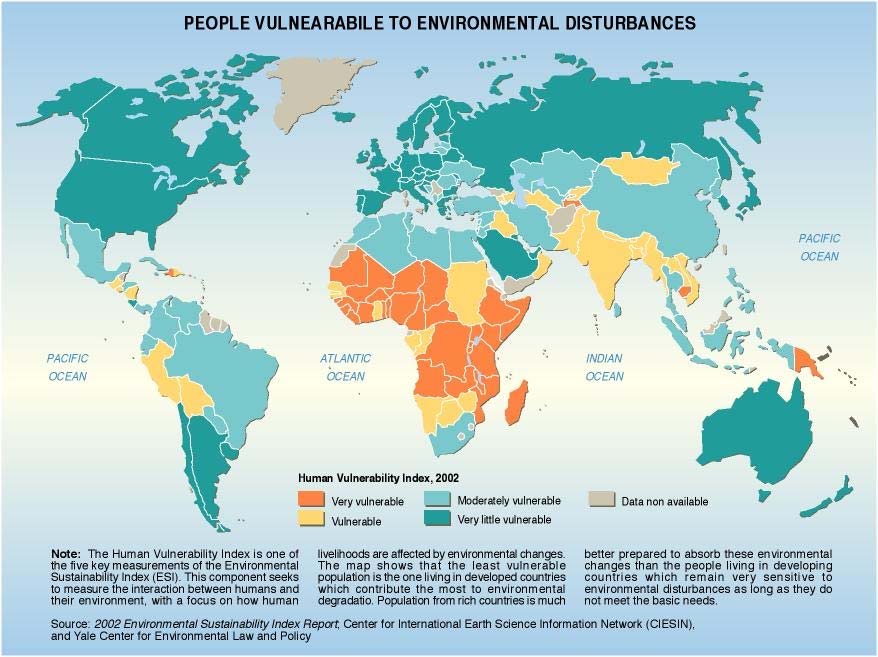
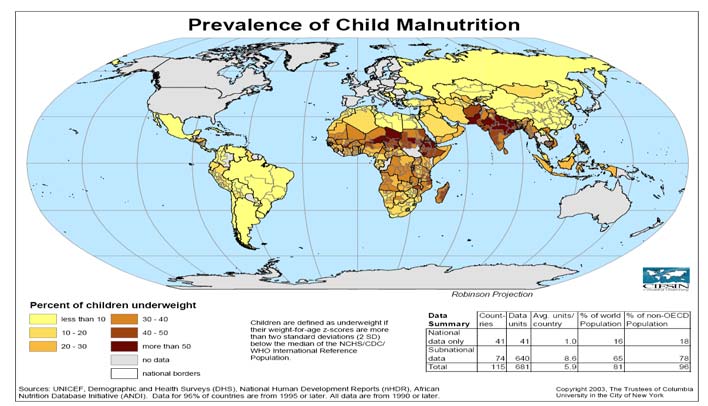
3. Poverty: Prevalence of Child Malnutrition (Columbia University, 2003)
The map presents the prevalence of child malnutrition as an indicator for poverty. Children are defined as
underweight if their weight-for-age z-scores are more than two standard deviations (2 SD) below the median of the
NCHS/CDC/ WHO International Reference Population. The map may be used to prioritize proposed project
interventions and, also, to identify areas where land degradation and poverty are closely linked and, therefore
must be addressed simultaneously.
4. Global Distribution of Vulnerability to Environmental Disturbances (CIESIN and Yale
Center for Environmental Law and Policy)
The map presents the different grades of vulnerability of people to environmental disturbances. The Human
Vulnerability Index is one of the five key measurements of the Environmental Sustainability Index. This component
seeks to measure the interaction between humans and their environment, with a focus on how human livelihoods are
affected by environmental changes. The map may be used to identify areas in which people are very sensitive to
environmental changes and least prepared to absorb them. The map may be used to prioritize actions in proposed
interventions on SLM on reducing the vulnerability of rural people to environmental disturbances such as land
degradation.
49
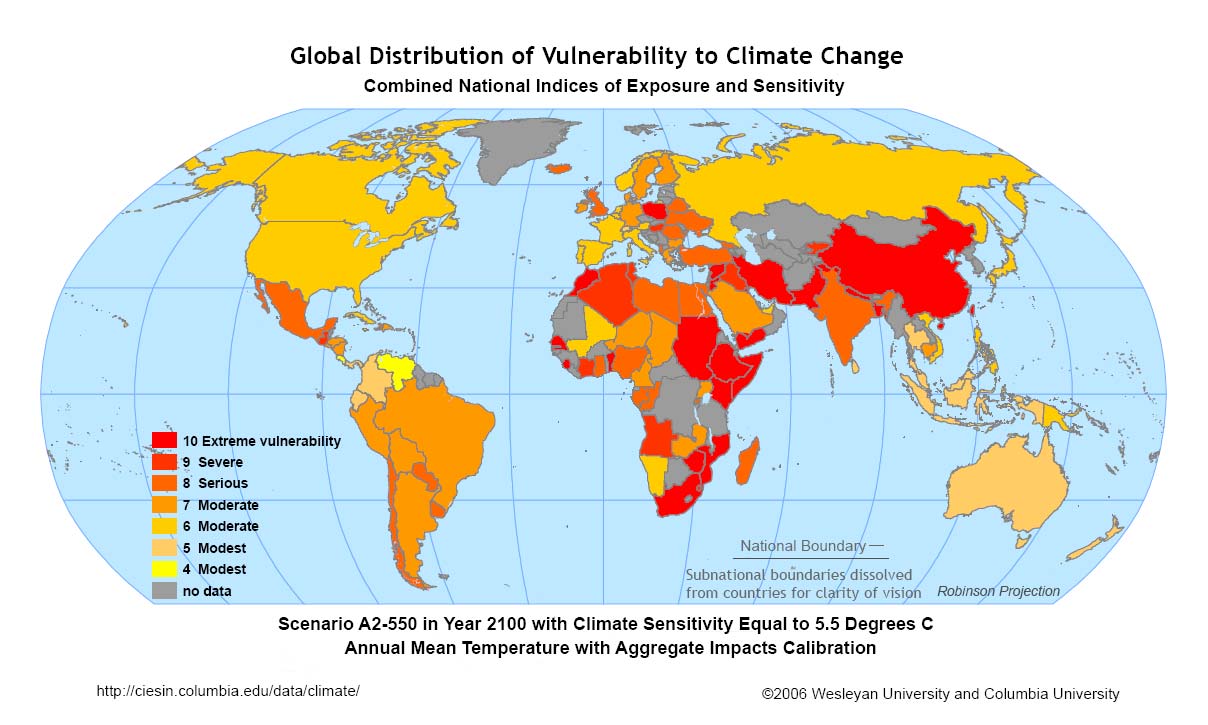
5. Global Distribution of Vulnerability to Climate Change
(Wesleyan University and Columbia University, 2006)
The map presents the vulnerability index to climate change, which combines both national indices of exposure and
sensibility. These indexes are related to the variation of the annual mean temperature in 2100 equal to 3.3°C,
calculated under the A2-550 ppm emission scenario (optimistic) and with climate sensitivity equal to 5.5°C (high
value). The potential impacts of such a variation have been aggregated in the indexes. The vulnerability spectrum
ranges from modest to extreme vulnerable. The map may be used to identify areas that may be at future risk of land
degradation due to impact of climate change. A comparison with the actual global land degradation map could help
us identify in particular those areas which are not at risk today, but which might be significantly affected by land
degradation in the near future, so that preventive actions are undertaken.
50
ANNEX 4. INTERNATIONAL WATERS FOCAL AREA STRATEGY
AND STRATEGIC PROGRAMMING FOR GEF-4
I. INTRODUCTION
1.
The GEF international waters focal area addresses sustainable development challenges
faced by states sharing transboundary surface, groundwater, and marine systems. These cross-
border challenges range from pollution, loss of critical habitats and biodiversity, ship waste and
alien species, to overuse and conflicting uses of surface and groundwater, over-harvesting of
fisheries, and adaptation to climatic fluctuations (e.g. associated droughts, floods, sea level rise,
reef bleaching).
2.
The 1995 GEF Operational Strategy defined the kinds of transboundary concerns to be
addressed under the International Waters (IW) focal area and recognized links between the focal
area and Agenda 21 Chapters 17 and 18 on oceans and freshwater. In support of Agenda 21 and
the transition to sustainable development, the IW area also contributes to human well being and
poverty eradication by sustaining livelihoods, securing food sources, promoting equitable access
to water, and reducing water-related health risks as a result of its interventions. With
transboundary complexities, these results take time to produce as trust and confidence must first
be built among states in a bottom-up process before progress can be made on water and ocean
security. This patience can pay off in generating political commitments that may sustain
collective, multi-country action over time.
II. BACKGROUND
3.
A decade of GEF experience with IW projects shows that interventions in multiple
countries with regional projects are more cost-effective than individual country projects in
gaining commitments to transboundary action. In addition, GEF builds trust and confidence for
sovereign states working together on shared water-related concerns in order to avoid political
conflicts among neighboring states and pursue joint development benefits, which has resulted in
building sustainable regional institutions for collective action after GEF support ends. This
strategy of using foundational processes to stimulate political commitment to collective action
and then scaling up with innovative policy, legal and institutional reforms and demonstrations
may take 10 years in individual transboundary water systems and successive GEF projects to
achieve. In fact, this would be a reduction in time over past experiences in the Rhine River
Basin, the North Sea and the North American Great Lakes, where action took many decades to
catalyze and continuing transboundary concerns about water, fisheries, habitat and pollution still
need attention.
4.
During GEF-4, the GEF Council-approved mandate of utilizing integrated, ecosystem-
based approaches to management of transboundary water systems will be stressed. This GEF
support places human activities at the center of the transboundary systems and bases
interventions on modifying those human activities so that multiple benefits may be sustained.
GEF has a long history of stimulating development of multi-agency collaboration in this focal
area and will continue to promote this collaboration to meet water-related development targets
agreed to by the international community, such as the Johannesburg targets. Partnerships among
51
agencies will continue to be pursued to assist them in working together more coherently within
comparative advantages consistent with country priorities and the United Nations reforms
currently being undertaken. Such collaboration among agencies contributes to increased
development effectiveness and synergies among GEF focal areas, and is essential to mobilize the
billions of dollars necessary to scale-up GEF work.
5.
The third independent Overall Performance Study of the GEF (OPS3) in 2005 and
internal reviews have documented success in use of GEF-recommended processes for achieving
the first strategic objective through its special capacity building or foundational projects
(equivalent to GEF enabling activities). OPS3 reported that outcomes have been robust, targets
set by the second and third replenishments were exceeded, and the focal area had proven to be an
effective agent for policy, legal and institutional reforms and for the creation of enabling
environments. OPS3 concluded that the IW focal area was ready to move from a testing and
demonstration mode to scaling-up of full operations in support of agreed incremental costs of
reforms, investments, and management programs needed to reduce stress on transboundary
freshwater and marine systems. This transition to implementing on-the-ground reforms and
stress reduction measures to meet the second Council-approved objective is the primary focus of
work for international waters during GEF-4; and with resources provided, a modest start can be
made.
III. DIFFERENCES BETWEEN GEF 3 AND GEF 4
6.
The GEF IW focal area was the only focal area to receive a decrease for GEF-4 over
GEF-3. The GEF-3 allocation was US$430 million while the GEF-4 amount is US$355 million
(although further reductions to support the GEF Small Grants Program and other priorities
reduce this to US$335 million). With less funding, fewer accomplishments should be expected
in GEF-4 as indicated by simple targets approved in the replenishment programming. The
availability of funding also results in a distinct focusing of the GEF-4 strategy on just a few top
priority transboundary water themes in order to better deliver results. Many of the other
transboundary concerns not listed as a priority have been requested to be added back in the
comments on previous drafts of this strategy. These suggestions have not been incorporated.
7.
While GEF-3 programmed resources through Operational Programs 8, 9, and 10, GEF-4
resources are programmed through four limited Strategic Programs. Projects previously
supported in GEF-2 and 3 often addressed general cooperation on transboundary waters and
preventive interventions. With limited resources, there will need to be a sense of country-driven
urgency about an imminent transboundary water concern included in the strategy for resources to
be programmed. In addition, oil-related ship pollution, inland fisheries, general pollution
concerns in basins, protected areas for transboundary wetlands, and general monitoring of
transboundary water systems would not be supported unless one of the four programming themes
is also involved. This does not mean that GEF will not address these important concerns in the
future. The priority setting included herein is just for GEF-4.
8.
Changes have also been made in comparison to the draft strategy Council reviewed in
December 2006. Based on comments from the Council and the International Waters Technical
Advisory Group, the third objective related to innovative demonstrations was incorporated into
52
the other two objectives and they are now expressed using wording from the original GEF
Operational Strategy. The two strategic objectives for GEF-4 represent a simplification and
focusing with respect to the three objectives included in December 2006 version. With existing
levels of GEF resources, focus will be placed on only a few globally significant transboundary
issues in order to increase the likelihood of significant impacts as part of a delicate balancing of
interests and pressing global transboundary concerns.
IV. STRATEGIC OBJECTIVES
9.
Realizing the complexity of these challenges, the difficulties that even developed states
continue to have in addressing these large transboundary water systems, and the decadal or
longer time frame for results to be measurable in large systems, the GEF Operational Strategy in
1995 adopted a stepwise catalytic approach, which was reflected in the two objectives for the IW
focal area:
(a)
to foster international, multi-state cooperation on priority transboundary water
concerns through more comprehensive, ecosystem-based approaches to
management; and
(b)
to play a catalytic role in addressing transboundary water concerns by assisting
countries to utilize the full range of technical assistance, economic, financial,
regulatory and institutional reforms that are needed.
10.
These two objectives adopted by the GEF Council remain valid today and will serve as
the strategic objectives (SOs) for GEF-4 as in the following table:
Table 1. Strategic Objectives for the International Waters Focal Area
Strategic
Expected Impacts
Indicators
Objective
1. To foster
Political commitments to improved
Multi-country agreements
international,
multi-country cooperation
multi-state
supporting sustainable economic
cooperation on development opportunities,
priority water
stability, and water-related security
concerns
in transboundary water systems
Co-financing Goal- 1:1
2. To catalyze
Participating states demonstrate the
Trend analysis supported by the GEF through
transboundary necessary ability to reduce over-
a new Transboundary Waters Assessment
action
exploitation of fish stocks, reduce
Program and additional states meet
addressing
land-based coastal pollution, and
Johannesburg (JPOI) targets on sustainable
water concerns balance competing water uses in
fisheries, IWRM, and ICM compared to 2006
basins and report subsequent water-
related improvements
Co-financing Goal- 2:1
11.
In the past, GEF has supported interventions addressing many different globally
significant transboundary water concerns. With GEF-4 resources being insufficient to continue
addressing all of these transboundary issues, the focal area will focus on four major
53
transboundary water-related priorities for GEF-4. These global concerns have emerged in recent
assessments such as the Millennium Ecosystem Assessment and the GEF Global International
Waters Assessment as posing grave risks to transboundary water ecosystems as well as serious
barriers to achieving sustainable development. The four global concerns are:
(a)
depletion of coastal and marine fish stocks and associated biological diversity;
(b) nutrient over-enrichment and oxygen depletion from land-based pollution of
coastal waters in Large Marine Ecosystems;
(c)
overuse and conflicting uses of water resources in surface and groundwater
basins; and
(d)
melting of ice in high-altitude basins and polar systems.
12.
As proposed in the GEF Replenishment Programming Paper (GEF/R.4/33), greater
resources will be devoted during GEF-4 to on-the-ground implementation and innovative
demonstration projects to meet Strategic Objective Two - perhaps 75% for implementation and
demonstrations compared to 25% for foundational capacity building and targeted learning for the
portfolio.
13.
Partnerships among agencies will be sought to leverage the billions of dollars of
resources necessary to secure the socio-economic benefits that transboundary water systems
provide to the communities that depend on them. These partnerships for scaling-up
implementation consistent with OPS3 recommendations for this focal area have been termed
"International Waters Partnership Investment Funds" beginning with approval of the
Danube/Black Sea Basin Investment Fund by the GEF Council in 2001. The expedited
procedures and predictability of resources in these investment funds provide incentives for
multilateral banks to make the decision to set internal priorities for sectoral action that can
leverage the scale of resources necessary to address such large-scale transboundary concerns.
GEF experience has been that piecemeal approaches are unable to provide the necessary
attention within multilateral banks to internalize these transboundary concerns, and GEF would
thereby not be successful in scaling up its operations to meet SO-2.
14.
An increased emphasis on targeted experience sharing and learning among the new and
existing GEF IW projects in the portfolio is planned to improve capacity of projects to achieve
objectives and to identify and replicate good practices before project completion. South-to-
South experience sharing among IW projects contributes to quality enhancement for the GEF IW
portfolio, development of knowledge management tools to capture good practices, and
accelerated replication of good practices. With the help of its IW:LEARN program, its web-
based resource center (www.iwlearn.net), and the GEF International Waters Task Force, this
portfolio learning is an important feature of GEF programming and will be enhanced with a
focus on many Africa IW operations now underway.
V. STRATEGIC PROGRAMS IN GEF-4
54
15.
The following sections describe four strategic programs in the international waters focal
area for GEF-4 that focus on the four priority global themes. They concentrate GEF resources on
the four concerns rather than scattering the resources. The two objectives for the focal area from
1995 remain overarching SOs for GEF 4. The two SOs are applied to the programming themes
to direct GEF level of effort, the outcome of which can be considered more specific application
of the SOs to each strategic program. For consistency with the GEF-4 Replenishment
Programming Paper, project results will be aggregated under each of the two strategic objectives
for reporting purposes.
Strategic Program 1: Restoring and Sustaining Coastal and Marine Fish Stocks and
Associated Biological Diversity
16.
Serious depletion of coastal and marine fish stocks and use of unselective and destructive
fishing practices are threatening coastal economies and the communities depending on them as
well as causing adverse impacts on biological diversity. US$ 60 billion in international trade in
marine fisheries products are at risk from this depletion as the oceans are being emptied of larger
species. In addition, other substances toxic to fish, biodiversity, and humans (hazardous algal
blooms and paralytic shellfish disease) are transferred across borders in ship ballast water.
17.
The impact of decline of fish stocks and destructive practices has serious implications for
loss of species and biomass of ecosystem structure, integrity and stability. Consequently, the
GEF IW focal area will join forces with biodiversity during GEF-4 to achieve cost-effective
solutions. Already, 123 different states have requested GEF help to work with their neighbors in
GEF IW foundational capacity building projects for almost one-half (14) of the planet's Large
Marine Ecosystems (LMEs) that are shared by developing countries in recognition of these
social and economic concerns. GEF-recommended processes are underway toward development
of ministerially-agreed collective programs of action that should benefit from use of marine
protected areas (MPAs). The International Code of Conduct for Responsible Fisheries was
adopted by the FAO Conference in 1995. GEF projects will be encouraged to utilize this
instrument in their work toward the JPOI.
18.
Where capacity is built and action programs agreed, GEF will support policy, legal, and
institutional reforms and multi-agency partnerships that contribute to WSSD targets for
sustaining fish stocks, including regional and national-level reforms in governance, access rights,
and enforcement, mostly in LMEs in order to utilize ecosystem-based approaches to assessment
and management of fish stocks in these critical systems. Also supported would be investments
in sustainable alternative livelihoods (such as aquaculture), habitat restoration, fish refugia,
limited use designations (including marine protected areas from the biodiversity area, especially
in Asia), technical assistance, less destructive gear to reduce stress on wild fish stocks and
biological diversity, and provisions of the 1995 International Code of Conduct for Responsible
Fisheries. Solutions to concerns on the high seas will be pursued as will be engagement of the
business community and fishing industry to develop and implement solutions and work with
GEF IW projects.
55
19.
A number of these interventions are appropriate for implementation within the
frameworks of Integrated Coastal Management (ICM). Consistent with the ecosystem-based
approach in addressing multiple stresses through ICM and linkages to upstream basin
management through Integrated Water Resources Management (IWRM), the focal area will
pursue collaboration on inter-linkages among GEF focal areas (especially biodiversity) that can
sustain livelihoods, food security, and coastal habitats as a contribution to marine-related
Johannesburg targets. These approaches can assist communities and states to adapt to fluctuating
fish stocks and coastal climatic regimes. Where SIDS are located in LMEs with continental
states, they will be supported as part of the GEF LME interventions as well as in possible
interventions in areas of high seas.
20.
Where capacity and agreement among states is not yet achieved for reducing depletion of
living resources, an enabling environment for action will be created through foundational
projects in states sharing a few additional LMEs as well as limited demonstrations addressing
invasive species in ship ballast water. Targeted learning projects will be undertaken for the IW
portfolio to enhance South-to-South experience sharing and learning, knowledge management
(KM), and capacity building to replicate good practices.
Strategic Program 2: Reducing Nutrient Over-Enrichment and Oxygen Depletion from
Land-Based Pollution of Coastal Waters in LMEs Consistent With the GPA
21.
Global assessments identify land-based pollution of coastal and marine waters and
resulting eutrophication as creating economically and ecologically problematic "dead zones" of
oxygen-deficient water. The problem is worsening globally and is caused by excessive levels of
nitrogen and phosphorus pollution and oxygen-demanding substances from agriculture, human
sewage, and industrial effluents. Recent projections forecast a doubling of nutrient loadings by
2050 in some areas such as Asia, with major impacts on communities and coastal economies.
22.
In 1995, a global action program known as the GPA (Global Program of Action for the
Protection of the Marine Environment from Land-based Activities) was adopted by over 100
countries in Washington, D.C. and a special provision was included in the Council-approved
GEF Operational Strategy for GEF support to countries for demonstration activities and catalytic
action toward reforms. With the situation of "dead zones" and nitrogen stimulation/degradation
of reefs worsening, more attention will be placed by GEF on this transboundary concern.
23.
Many bilateral and multilateral programs focus on sanitation and ignore sewage and
agriculture pollution, which are major contributors to the growing problem that contributes to
decline of coastal and marine fisheries. As a result of projections showing major nutrient
pollution and "dead zone" concerns developing in Asia, the GEF IW focal area will join forces
with the land degradation focal area on this in East Asia and will assist countries elsewhere to
reduce land-based pollution, including a focus on SIDS to protect reefs and lagoons.
24.
GEF will foster ecosystem-based approaches to assessment and management of LMEs
that include reducing land-based pollution and the resulting eutrophication of coastal "dead
zones" in support of the GPA. Where capacity is built and collective action agreed upon,
support will be provided for national/local policy, legal, and institutional reforms to reduce land-
based inputs of nitrogen and other pollutants consistent with agreed transboundary action
56
programs and the GPA. This includes incorporation of nutrient reduction into national and local
ICM strategies. Innovative partnerships, investments and financing will be pursued (including
use of revolving funds and investment funds) addressing agriculture, municipal, and industry
sector pollution and for wetland restoration/enhancement (including use of locally acceptable
ecological sanitation and simple treatment in support of Johannesburg targets--especially in
SIDS). A focus on Asia with the land degradation area will be targeted to incorporate nutrient
management and cycling in agriculture to address non-point sources of pollution. The business
community will be engaged in solutions, and attention will be paid to environmental flows in
rivers to ensure sustenance for downstream coastal ecosystems.
25.
Where capacity is not yet built to address these GPA-related concerns, an enabling
environment for action will be created though foundational projects for a number of new
transboundary systems, working with external networks related to pollution sources and external
initiatives, and targeted learning will be undertaken for the IW portfolio to enhance South-to-
South experience sharing and learning, knowledge management, and capacity building to
replicate good practices.
Strategic Program 3: Balancing overuse and conflicting uses of water resources in
transboundary surface and groundwater basins
26.
Overuse and conflicting uses of water resources in transboundary surface and
groundwater basins result in significant ecological and economic damage, reduced livelihoods
for the poor, and increased political tensions among upstream and downstream states. With
more frequent droughts and floods, the conflicts and water scarcity increase dramatically.
Additionally, shallow groundwater over-extraction and saline intrusion along coasts are
becoming major global threats to human development and environmental sustainability.
27.
Use of Integrated Water Resources Management (IWRM) policies has been identified as
the answer to balancing competing and conflicting uses of water resources to inform and
consider tradeoffs being made in socio-economic development objectives and ecosystem
protection. These hydrologic unit-based IWRM approaches provide a framework for practical
considerations in tradeoffs among water resource uses with participation of stakeholders and
support the incorporation of benefits across boundaries into decision-making. Targets related to
IWRM were adopted at the Johannesburg Summit. Links between IWRM in basins and ICM at
downstream coasts are of pivotal importance as transboundary cooperation contributes to
securing not only local waters uses but also global public goods that benefit all stakeholders.
28.
Through GEF assistance, capacity is being built in many African states through
foundational projects in one dozen transboundary surface/groundwater basins to take the next
steps in implementing IWRM and other modern water resource management policies to improve
water security for communities, reduce conflicts among states, improve ecological flows in
basins, and adapt to fluctuating climatic regimes. Over time, these interventions contribute to
improved community livelihoods, increased crop yields where unsustainable irrigation practices
are used, improved environmental flows, and reduced health risks where pollutants create such
risks. The global water crisis results from a crisis of governance that has to be addressed at the
transboundary scale in addition to the national and local scales.
57
29.
Where capacity is built to work jointly in transboundary surface and groundwater basins,
GEF will support the balancing of conflicting/competing water uses through application of
IWRM, enhanced functioning of joint management institutions, integrated natural resources
management across focal areas, groundwater being systematically incorporated into surface
water management; improved flow regimes from infrastructure developed, protected water
supplies, enhanced groundwater recharge, and increased resilience to fluctuating climatic
regimes. With only modest resources available during GEF-4, this program is aimed primarily at
quantity issues where competing water uses create priority and urgent concerns. Priority is also
accorded to integrated approaches across GEF focal areas where multiple benefits may be
generated because of inter-linkages such as with sustainable forest management. This may entail
reforestation to protect groundwater recharge areas or to control erosion and soil loss in the
upper reaches of watersheds with benefits in flow regulation and the hydrological balance of
upper watersheds. Such cases of watershed intervention may include tests of payments for
environmental services in various forms.
30.
A limited number of sectoral demonstration activities will be undertaken to test
innovative approaches, financing, and technologies for introducing IWRM as well as to
protect/enhance groundwater supplies, especially in SIDS where multiple benefits can be gained
in protecting drinking water supplies; reducing coastal pollution; and adopting ICM strategies.
Groundwater-related and water reuse demos in the North Africa/Middle East region would be
pursued in collaboration with the GEF land degradation focal area.
40.
The approaches in this strategic program are recognized as being quite broad. There
have been few requests to GEF in the past for these types of interventions compared to requests
for marine assistance. Since the last replenishment, the potential importance in balancing these
competing uses among states and among sector uses within cooperating states has increased as a
result of security and stability concerns, and sovereignty interests among states need such a
broad initial approach to catalyze progress. Where capacity is not yet built, an enabling
environment for IWRM will be pursued in states sharing transboundary freshwater systems.
Additionally, targeted learning will be undertaken for the IW portfolio to enhance experience
sharing and learning, knowledge management, and replication of good practices that contribute
to sustaining livelihoods as well as food and water security.
Strategic Program 4: Adapting to Melting Ice in High Altitude Basins and Polar Systems
41.
Ice is a dominant characteristic of frozen transboundary waters in polar and high altitude
ecosystems. Recent global assessments identify significant accelerated reduction of the spatial
extent and mass of polar and glacial ice, creating significant ecological and economic changes of
global significance and water stress for downstream communities and downstream states in
transboundary basins. The problem is worsening globally and is accelerated by global warming
that affects the national productivity of goods and services of marine polar ecosystems and the
ice-water balance of high altitude glacial basins. With literally billions of people depending on
slow ice and snow melt for downstream water supplies, the future stability and sustainability of
their cities and villages are at risk.
42.
Adding to the stress on polar systems and downstream water supplies are toxic
compounds like heavy metals that settle out in cold regions from distant sources as a result of
58
rapid industrialization and energy use. In fact, many of these toxic substances have been stored
in ice from airborne releases since the start of the industrialization on the planet, and additional
risks are posed to ecosystems and human health from the melting and remobilization of them.
Many of these compounds are toxic to animals, persist in the environment, and cross national
borders to: a) bio-accumulate in freshwater and ocean food chains; and b) pose risks to
ecosystem and human health. While POPs are a small subset of 12 such compounds, persistent
toxic substances (PTS) pose significant health risks in food such as finfish, shellfish, and wildlife
consumed by predators ranging from birds to polar bears and humans as well as locally in water
supplies and through inhalation pathways wherever they are released into air or water.
43.
In 1995, the GEF Council included demonstration projects to reduce releases of these
PTS in the international eaters focal area and subsequently in Operation Program 10. With many
waters becoming unusable because of toxic pollutants and the accompanying risks to ecosystem
and human health (especially with endocrine disruptors), there is a need to increase GEF's
attention to reduction of PTS. Additionally, the tendency for PTS releases to accumulate in cold
regions - with its risks to animals and humans that populate those regions and the complex
socioeconomic implications presented by the melting ice - mean that the limited demonstration
projects undertaken in GEF-4 on this programming theme will likely take on more significance
in future GEF cycles.
44.
GEF will foster ecosystem-based approaches to adaptive management for ice reduction
effects in polar Large Marine Ecosystems and glacially dominated high altitude river basin
systems, including the reduction of PTS as part of the GEF chemicals strategy. Consequently,
this strategic program will be jointly addressed by GEF interventions in the international waters,
climate change, and POPs focal areas. Ecosystem-based approaches involving living resources
of the Arctic LMEs and basins from headwater ice to downstream coastal areas (consistent with
IWRM strategies) would be utilized to undertake the demonstration projects. This would be a
limited effort used to gather experiences for use in programming for subsequent replenishments
of GEF.
45.
Where capacity can be built and collective action agreed upon in transboundary settings
(or among ministries in national basins), support will be provided for national/local policy, legal,
and institutional measures for adaptive management to adjust to the reductions in ice cover and
melt. This may involve the establishment of IWRM in basin organizations, drought management
planning, demostrations of water-use efficiency in water using sectors, and alternative sources of
water supplies. In basins draining high-altitude ice, development of basin-specific IWRM
adaptive management plans will provide a tool for downstream sectors and communities to
adjust to new realities of water availability and drought management planning. Limited
assessments would be supported, including mainstreaming assessments of polar marine systems
and headwater ice fields into the GEF Transboundary Waters Assessment Program. Benefits
would be provided to water users and water-dependent ecosystems in transboundary systems and
in testing means of adapting to melting ice.
46.
With regard to PTS, a limited demonstration component beyond POPs will be supported
to test effectiveness of policies, innovative instruments, and technologies for reducing releases of
these toxic substances, and to engage the business community in developing solutions to
59
demonstrate cost-effectiveness and "pollution prevention pays" strategies in support of the GEF
Sound Chemicals Management Strategy. A number of economic sectors and transboundary river
basins with risks from PTS or other toxic substances would be the subject of pilot
demonstrations, with the results and experiences compiled for possible future GEF application.
Some benefits are expected in cold regions as PTS releases are reduced in the special
demonstration projects and transboundary test basins.
VI. SUMMARY OUTCOMES FOR STRATEGIC PROGRAMS IN IW
46.
The summary of outcomes for each strategic program and indicators to be tracked is
included in the following table. Some indicators will be tracked annually in the project
performance reporting process and others only several times in the life of projects. The IW
Tracking Tool tested in 2006 annual performance reporting will be modified to support the roll-
up of the indicators. Targets were previously established in the replenishment process and
progress will be rolled up annually. A GEF Transboundary Waters Assessment Program is
planned to support monitoring of trends globally in transboundary water systems on a five-year
scale. This assessment program will be utilized to track progress toward GEF IW strategic
objective 2. This periodic assessment will also provide a more systematic assessment of
transboundary water systems at risk, and early warning of potential conflicts and declining
status.
Table 2: International Waters Strategic Programs
Strategic Program
Expected Outcomes
Indicators
SP-1: Restoring and
· Political commitments made to · National inter-ministry committees
sustaining coastal and marine
ecosystem-based joint action
· Ministerially-agreed action
fish stocks and associated
on sustainable fisheries and
programs and local ICM plans
biological diversity
integrated coastal management
adopted
(ICM)
· Regional, national and local policy,
· Institutions and reforms
legal, and institutional reforms
introduced to catalyze
adopted; evaluations show
Initial attention to global hot
implementation of policies
implementation effectiveness
spots in Sub-Saharan Africa,
reducing over-fishing and
· Fish stock and habitat assessments
Southeast Asia/Pacific, and
benefiting communities
· Per capita incomes at demo sites
Latin America/Caribbean Large · Multi-agency partnerships
· Incorporation in CAS, UN
Marine Ecosystems (LMEs),
catalyze replication of
frameworks, PRSPs, One UN
and accelerated entry into force
innovations
· Number/extent of MPAs in
of the global ship ballast water/ · Increased coverage of marine
national PA systems
invasive species convention
protected areas (MPAs)
60
SP-2: Reducing nutrient over- · Political commitments made to
· National inter-ministry committees
enrichment and oxygen
nutrient and other pollution
· Ministerially-agreed LME and basin
depletion from land-based
reduction and ICM
action programs and local ICM plans
pollution of coastal waters in
· Institutions and reforms
adopted
LMEs consistent with the
introduced to catalyze
· National and local policy, legal, and
GPA
implementation of policies for
institutional reforms adopted;
coastal pollution reduction and
evaluations show implementation
Initial efforts expected on
ICM
effectiveness
nutrient and land-based
· Multi-agency partnerships
· Monitoring levels of nutrient releases
pollution reduction in East
catalyze replication of reforms
at demo sites
Asian LMEs and the
and innovative investments for
· Joint action adopted by regional
Mediterranean Sea LME, as
nutrient reduction
institutions on nutrient reduction
well as on creating an enabling
· Incorporation in CAS, UN
environment for action
Frameworks, One UN, Bilateral
elsewhere
programs
SP-3: Balancing overuse and
· Political and legal
· National inter-ministry committees
conflicting uses of water
commitments made to utilize
· Ministerially-agreed action programs
resources in transboundary
IWRM policies towards
and basin IWRM plans adopted
surface and groundwater
sustainable water use in
· National water resource and IWRM
basins
transboundary basins
reforms/policies adopted; evaluations
Requests expected for the great · Institutions and reforms
show effectiveness
basins of South America
introduced to catalyze
· Regional/basin agreements and
experiencing climatic
implementation of policies for
institutions adopted; evaluations
fluctuations with additional
basin-scale IWRM and
show effectiveness
work in African basins and the
increased water use efficiency
· Monitoring level of water use
Mekong to introduce IWRM
· Communities benefit from
efficiency in demonstrations
policies. Special focus on SIDS
access to water-related benefits
· Access determined in evaluations
included for protecting
in tests of innovative
· Monitoring levels of sewage
community surface and
demonstrations of balancing
treatment and water supply
groundwater supplies while
water uses
protection measures in SIDS
reducing sewage releases.
· In SIDS, water-related health
Groundwater protection
risks reduced through
strategies would be tested
protected water supplies
SP-4: Adapting to melting ice
· Adaptive management
· Ministerially-agreed action programs
in high-altitude basins and
measures identified, agreed
and basin IWRM plans adopted
polar systems
upon, and tested in a limited
· Monitoring level of PTS releases at
number of basins with high-
demonstration sites
altitude headwaters and one
· Industry codes of conduct, new
polar LME
private sector initiatives
A limited program testing
· Reduction of human and
strategies to adapt to melting
ecosystem health risks from
ice and to reduce releases of
PTS at demo sites
persistent toxic substances
· Incorporation of pollution
(PTS) to inform future GEF
prevention strategies for PTS
replenishments
into private sector operations
VII. INTER-LINKAGES WITH OTHER FOCAL AREAS
61
48.
While one priority theme will serve as a focus for an international waters operation, there
will be opportunities to address interlinked transboundary concerns as part of the ecosystem
approach and provide multiple global environment benefits across focal areas through the inter-
linkages. Cost-effective approaches of joining forces with other GEF focal areas for multiple
benefits will be pursued, and partnerships are to be catalyzed to leverage the billions of dollars
necessary to secure the socio-economic benefits that transboundary water systems provide to the
communities that depend on them. The cost-effectiveness of such joint operations will be
documented to inform GEF operations for future replenishment periods.
49.
Twelve components of the strategic programs are proposed to address the four priority
programming themes that have been identified. The individual projects in these components will
be consistent with the GEF IW ecosystem-based approach to management for basins and LMEs,
and partnerships will be stimulated with use of GEF International Waters Investment Funds,
institutional reforms, and innovative financing to scale-up interventions into the billions of
dollars needed to turn the corner on sustaining socio-economic benefits of transboundary water
systems. Additionally, a number of projects involving SIDS in the IW pipeline will be combined
with activities of other GEF focal areas into larger programs for regional groupings of SIDS.
Experience-sharing and learning projects for the IW portfolio will be utilized to support the four
strategic programs to build capacity and encourage replication of good practices in a spirit of
adaptive management. These range from institutional and science-based learning to thematic and
regional experience-sharing such as initiatives for the Africa IW portfolio and building on almost
completed work in Eastern Europe.
50.
The following table summarizes the components of each strategic program that provide
opportunities for integration. The IW focal area proposes joining forces with some operations in
other GEF focal areas in up to nine of the twelve components to achieve objectives more
completely and perhaps more cost-effectively. This would be accomplished in a number of
ways: from jointly-funded projects to individual projects in separate focal areas with linkage
components. Not all projects within each component would necessarily have to be jointly
undertaken with another focal area, and RAF limitations may end up precluding collaboration.
62
Table 3: Potential Interlinkages Between International Waters and Other Focal Areas
SP-1: Restoring and sustaining coastal
· Africa Regional LME Component (IW/BD)
and marine fish stocks and associated
· Latin America/ Caribbean Regional LME Component (IW/BD)
biological diversity
· Reducing invasive species in ship ballast water (IW/BD)
SP-2: Reducing nutrient over-
· East Asia Regional LME Component (IW/LD)
enrichment and oxygen depletion from · Mediterranean Sea LME Component (IW/ POPs/ BD)
land-based pollution of coastal waters
· Global Component
in LMEs consistent with the GPA
SP-3: Balancing overuse and
· South America Basin Component (IW/CC)
conflicting uses of water resources in
· Pantanal basin (IW/BD/LD)
transboundary surface and
· Groundwater component including NENA Region (IW/LD)
groundwater basins
· Global Component
SP-4: Adapting to melting ice in high-
· Polar and melting ice component (IW/CC)
altitude basins and polar systems
· PTS reduction component (IW/POPs)
63
ANNEX 5. PERSISTENT ORGANIC POLLUTANTS FOCAL AREA STRATEGY
AND STRATEGIC PROGRAMMING FOR GEF-4
1.
The GEF's goal in the POPs focal area is to protect human health and the environment by
assisting countries to reduce and eliminate production, use and releases of POPs, and
consequently contribute generally to capacity development for the sound management of
chemicals.
2.
For the period of GEF-4, this goal will be met through:
(a)
strengthening capacities for National Implementation Plan (NIP) development
and implementation, including assisting those countries that lag farthest behind to
establish basic, foundational capacities for sound management of chemicals;
(b)
partnering in investments needed for NIP implementation to achieve impacts in
POPs reduction and elimination; and
(c)
generating and disseminating knowledge to address future challenges in
implementing the Stockholm Convention.
I. BACKGROUND
Environmental and Human Health Consequences of Exposure to POPs
3.
Mounting evidence of damage to human health and the environment has focused the
attention of the international community on persistent organic pollutants (POPs). POPs are
pesticides, industrial chemicals, or unwanted by-products of industrial processes or combustion.
They are characterized by: persistence the ability to resist degradation in various media (air,
water, sediments, and organisms); bio-accumulation the ability to accumulate in living tissues
at levels higher than those in the surrounding environment; and potential for long range
transport the capacity to travel great distances from the source of release through various
media (air, water, and migratory species).
4.
Because of these properties, POPs are found throughout the world, including in areas far
from their original source. The harm these chemical substances can cause to humans and animals
includes disruption of the endocrine system, suppression of the immune system, reproductive
dysfunction, and developmental abnormalities.
5.
Although most intentionally-produced POPs have been banned and are being phased out
in OECD countries, the situation in developing countries, and particularly in Least Developed
Countries, is one characterized in many instances by inadequate legislative and regulatory
frameworks, coupled with the near absence of capacity for enforcement and lack of awareness of
the hazards associated with POPs exposure. As a result, the limited local capacity can lead to
64
regional and ultimately global contamination of the environment by POPs, with damage to the
health and well-being of human populations, particularly the poor that are at greatest risk25.
Convention Guidance
6.
The Stockholm Convention on Persistent Organic Pollutants that was adopted in May
2001 and entered into force in May 2004 designates the GEF as the principal entity entrusted
with the operations of the financial mechanism of the Convention, ad interim. The first meeting
of the Conference of the Parties (COP) adopted guidance26 for the financial mechanism that
emphasises capacity building and establishes the NIP as the main driver for implementation
activities. Specifically, the COP recommended that resources should be allocated to activities
"that are in conformity with, and supportive of, the priorities identified in [parties'] respective
national implementation plans."
7.
The COP at its second meeting in May 2006 adopted additional guidance27 for the GEF,
inviting in particular the GEF and its agencies to facilitate the leveraging of other sources of
financing for the implementation of the Convention.
Knowledge Management
8.
In pursuing the following strategic programs, the GEF will support the generation and
dissemination of good practices and the development of practical guidelines, so that lessons
learned from GEF projects and good practices in general are incorporated into the design of new
GEF projects. Specific themes that could be analyzed include PCB management, NIP
development, alternatives to DDT use in disease vector control or to POPs used as termiticides,
or the application of the guidelines for best available techniques and best environmental
practices. Themes that cut across sectors or groups of projects could also be considered, for
example good practices in stakeholder involvement, or private sector participation.
Measuring Results
9.
A number of indicators for each strategic program are described herein. Taken together,
these constitute the POPs focal area tracking tool that is the basis for tracking progress in the
implementation of the POPs focal area strategy, and will allow reporting on results and impacts
for the focal area overall.
10.
These indicators do not purport to be the only ones that could be used to describe
achievements under a particular strategic program. The intent in selecting these indicators was to
choose a limited number of indicators that could be measured and added up to provide a
meaningful overview of portfolio achievement. Each individual POPs project will include, at the
minimum, one of these indicators in their results matrix. It is expected, of course, that individual
25 See Toxics and poverty: the impact of toxic substances on the poor in developing countries, Goldman L. and Tra
N., The World Bank, 2002.
26 Decision SC-1/9 can be found in the annex to the meeting report from COP-1 (document
UNEP/POPS/COP.1/31):
http://www.pops.int/documents/meetings/cop_1/meetingdocs/report/default.htm.
27 Decision SC-2/11 can be found in the annex to the meeting report from COP-2 (document
UNEP/POPS/COP.2/30): http://www.pops.int/documents/meetings/cop_2/report/default.htm.
65
projects would also include other indicators to track all dimensions of expected project results,
but these could differ between projects and may not contribute to the broad overall assessment of
focal area-wide achievements.
11.
The indicators encompass enabling environment indicators (e.g. regulatory framework in
place, or increased capacity for enforcement) and stress reduction indicators (e.g. number and
unit cost of tons of PCB destroyed in an environmentally sound manner, or amount and unit cost
of avoided emissions of by-products). Environmental impacts will be assessed in the framework
of the overall evaluation of the effectiveness of the Convention.
12.
Targets: There is insufficient experience with the implementation of the Stockholm
Convention to define targets upfront for all the indicators that are defined here. The tracking
tool, however, will permit an accurate reporting of expected results at the end of the
replenishment period and this will, in turn, facilitate the development of targets in the future.
Cost-effectiveness
13.
Cost-effectiveness is one of the core principles of the GEF Operational Strategy. A cost-
effective POPs project is one that achieves the requisite outcomes generating global benefits at
the least cost, promotes replication, and is sustainable. Cost-effectiveness is one of the tools that
are used during project development to support the analysis of, and ultimately the choice
between, different project approaches. Cost-effectiveness can also be a useful tool for setting
priorities in the context of limited resources and implementation capacity.
14.
A rudimentary proxy of cost-effectiveness is the measure of the unit-cost of POPs phased
out from use or production, or destroyed in an environmentally sound manner, or not released
into the environment. Although this proxy cannot by itself be used to judge the merit of an
intervention, it is a tool that will be recorded and reported to facilitate benchmarking.
II. STRATEGIC OBJECTIVE
15.
The GEF's goal in the POPs focal area is to protect human health and the environment by
assisting countries to reduce and eliminate production, use, and releases of POPs, and
consequently contribute generally to capacity development for the sound management of
chemicals.
16.
The long term impact of GEF interventions is a reduction in the exposure to POPs of
humans and wildlife. The indicator for this reduction of exposure is a decrease in the observed
concentration of specific POPs chemicals in the environment. This global level indicator is to be
assessed within the framework of the efforts of the Conference of the Parties to evaluate the
effectiveness of the Convention, as required by Article 16 of the Convention.
17.
The strategic objective of the GEF under the POPs focal area, in the mid-term and
spanning a number of replenishments, is to assist eligible partner countries to implement their
obligations under the Stockholm Convention and to achieve the purposes of the convention,
including to reduce and eliminate production, use and releases of POPs. Table 1 presents the
expected impacts of GEF interventions in the POPs focal area under GEF-4.
66
Table 1: GEF Strategic Objective in the POPs Focal Area
Strategic Objective
Expected impacts
Main Indicators
To reduce and
GEF-supported countries have strengthened
Regulatory and enforcement
eliminate
capacity for POPs management and consequently
capacity in place
production, use and strengthened capacity for the general sound
releases of POPs
management of chemicals
Dangerous obsolete pesticides that pose a threat to Obsolete pesticides disposed of
human health and to the environment are disposed
of in an environmentally sound manner
PCBs, some of the most widespread toxics, are no PCBs phased out and disposed of
longer a source of contamination of the local and
global environment because they are phased out
and disposed of
The risk of adverse health effects from POPs is
Reduced risk of exposure to POPs
decreased for those local communities living in
of project-affected people
close proximity to POPs wastes that have been
disposed of or contained
The basis for the future implementation of the
Knowledge management
Stockholm Convention is established through the
packages developed; in particular,
demonstration of innovative alternative products,
the viability and cost-
practices, and processes to the generation, use or
effectiveness of alternatives to
release of POPs
DDT are demonstrated in a
number of settings
III. STRATEGIC FOCUS IN GEF-4
18.
GEF-3 efforts focused on supporting the development of National Implementation Plans
(NIPs) as required in Article 7 of the Stockholm Convention; as of December 31, 2006, enabling
activities to develop a NIP are underway in 131 countries. Of these, 93 countries have either
completed their enabling activities or will soon do so. This total includes 26 countries that have
already officially submitted their NIP to the COP of the Stockholm Convention.
19.
Activities during GEF-4 will therefore be characterized by a shift from preparation to the
implementation of NIPs. In order to achieve the long-term success of the Stockholm
Convention, strong emphasis will be placed on the sustainability of GEF interventions, focusing
especially on countries whose policies and actions demonstrate their firm intention to follow
through on their commitment to the Convention.
20.
Projects addressing unintentionally produced POPs are expected to be mostly of a
planning and strategy development nature under GEF-4, thereby preparing the groundwork for
more systematic efforts that will be required in future phases of the GEF28.
28 The Stockholm Convention COP will be considering for adoption the guidelines for best available techniques/best
environmental practices at its third session in May 2007.
67
21.
Under GEF-5, the following trends are expected: a further shift towards implementation,
with strategic program 2 gaining pre-eminence over strategic program 1; a more systematic
approach to unintentionally produced POPs, DDT alternative,s and alternatives to POPs
termiticides, reflected by these themes being addressed under strategic program 2 rather than
strategic program 3; work to support countries' participation in the evaluation of the
effectiveness of the Stockholm Convention; and a round of review and update of the NIPs, in
particular when new POPs are added to the Convention29.
IV. STRATEGIC PROGRAMS IN GEF-4
22.
Three strategic programs are proposed for implementation under GEF-4, and are
described below and in Table 2. All projects approved under GEF-4 are expected to contribute to
at least one of these programs.
Strategic Program 1: Strengthening Capacities for NIP Development and Implementation
23.
Objective (a) NIP Development: The GEF will continue to support eligible countries in
meeting their obligation to develop and submit a NIP under the Stockholm Convention (enabling
activities).
24.
Outcome: GEF eligible countries meet their obligation to develop and submit a NIP to
the COP of the Stockholm Convention.
25.
Indicators: Two indicators of output and outcome are to be tracked through the GEF-4
replenishment:
(a) NIPs submitted to the COP of the Stockholm Convention30; and
(b) number of countries receiving support to develop their initial NIP.
26.
Scope: Efforts will be made to ensure that the NIP development process is embedded in
a country's institutional framework for the sound management of chemicals, thereby
contributing to strengthening that framework.
27.
Priority Countries: This program will remain a priority for the small number of
eligible31 countries that have not yet prepared their NIPs. It is expected that this will complete
the GEF's funding of the initial NIP.
28.
Types of Projects: Projects to be implemented under this program will be largely
oriented towards enabling activities.
29 As of March 2007, 10 chemicals/families of chemicals are under consideration by the subsidiary body of the
Convention for possible recommendation of listing under the Convention.
30 Parties to the Stockholm Convention have an obligation to submit a NIP to the COP of the Convention within two
years of becoming a party.
31 Following Convention guidance, the GEF Council has extended eligibility of POPs enabling activities to
developing countries and countries with economies in transition "that are in the process of becoming Parties to the
Stockholm Convention".
68
29.
Objective (b) - NIP Implementation: The GEF will strengthen and/or build the capacity
required in eligible32 countries to implement their Stockholm Convention NIPs in a sustainable,
effective and comprehensive manner, while building upon and contributing to strengthening a
country's foundational capacities for sound management of chemicals.
30.
Outcomes: GEF eligible countries have the capacity to implement the measures required
to meet their obligations33 under the Convention, including POPs reduction measures. As such
measures will address the full range of chemicals (pesticides, industrial chemicals and
unintentionally produced by-products), countries will be implementing measures that will
improve their general capacity to achieve the sound management of chemicals.
31.
Indicators: The following outcome indicators are proposed as a measure of capacity
development for NIP implementation:
(a)
legislative and regulatory framework in place in supported countries for the
management of POPs and chemicals in general;
(b)
strengthened and sustainable administrative capacity, including chemicals
management administration within the central government in supported countries;
and
(c)
strengthened and sustainable capacity for enforcement in supported countries.
32.
Scope: Following Convention guidance, activities supported will be in conformity with,
and supportive of, the priorities identified in countries' respective NIPs. Depending on NIP
priorities, interventions can include strengthening legislative and regulatory frameworks;
strengthening of human and institutional capacity; strengthening of monitoring and enforcement
capacity; development and implementation of instruments to secure resources for NIP
implementation; and raising awareness of, and engaging with, various non-governmental
stakeholders including the private sector.
33.
This program will include assisting those countries that lag the farthest behind to
establish basic foundational capacities for the sound management of chemicals. Cooperation and
coordination to enhance synergies with countries' responses to related multilateral
environmental agreements34 addressing chemicals issues will be encouraged. These two latter
points constitute an operational response to the amendment of the GEF Instrument (Article 1,
Paragraph 3, as amended in 2004) that provides that "the agreed incremental costs of activities to
32 Since the pertinent EU legislation imposes stricter obligations on EU member states than does the Stockholm
Convention, no funding for EU member states is foreseen (Regulation EC No. 850/2004 on persistent organic
pollutants).
33 The COP of the Stockholm Convention will be considering for adoption at its third session the draft
implementation plan for the global monitoring plan for the first effectiveness evaluation of the Convention. This
would include the identification of monitoring programs that, with strengthening of capacity, could provide data
coverage in areas otherwise inadequately represented. The GEF will keep a watchful brief with a view to defining
support that may be provided to strengthen the capacity of eligible countries to support the implementation of COP
decisions related to effectiveness evaluation, through country-driven and sustainable activities consistent with the
GEF's mandate. This could lead to specific indicators and targets under future phases of the GEF.
34 For example Basel and Rotterdam Conventions and the SAICM.
69
achieve global environmental benefits concerning chemicals management as they relate to the
[six] GEF focal areas shall be eligible for funding."
34.
Priority Countries: Support under this high priority program should be targeted to
countries that have limited capacity to implement their NIP. Countries must demonstrate a
willingness to adopt the necessary policies and to continue support for the institutions
strengthened with GEF support, for example through inscribing support for POPs management
and reduction activities in the national budget. It is therefore expected that those countries that
will receive support for capacity strengthening under GEF-4 will not require any such support to
meet current obligations of the Stockholm Convention under future phases of the GEF.
35.
Types of Projects: Projects to be implemented under this program will be largely
oriented towards technical assistance and capacity building.
Strategic Program 2: Partnering in Investments for NIP Implementation
36.
Objective: The GEF will partner in investments needed for NIP implementation to
achieve impacts in the reduction of POPs production, use and releases, and reduce the stress on
human health and the environment caused by POPs, including through promoting the use of
substitute products or alternative practices that prevent or reduce the generation and/or release of
POPs.
37.
Outcome: Sustainably reduced POPs production, use and releases, through phase-out,
destruction in an environmentally sound manner, and use of substitute products and alternative
processes, that lead to reduced environmental and health risks resulting from POPs.
38.
Indicators: The following four indicators35 are proposed to track results under this
program:
(a)
POPs phased out from use (tons and cost per ton per compound);
(b)
POPs phased out from production (tons and cost per ton per compound);
(c)
POPs destroyed in an environmentally sound manner (tons and cost per ton per
compound and mode of destruction); and
(d)
reduced exposure to POPs, measured as the number of people living in close
proximity to POPs wastes that have been disposed of or contained.
39.
Scope: Following Convention guidance, activities supported will be in conformity with,
and supportive of, the priorities identified in countries' respective NIPs. Projects will seek to
reduce POPs production, use and releases through phase-out, destruction in an environmentally
sound manner, and use of substitute products and alternative processes. The precise nature of
these interventions will be defined by the NIP, and could include for example the identification,
labelling, removing from use and disposal in an environmentally sound manner of PCBs; the use
35 Not all projects under this program will necessarily destroy POPs, but could decrease the risk of POPs releases
and human exposure, for example through maintaining a PCB transformer or containment of soil contamination.
70
of non-POPs alternative products and practices for disease vector or termite control; or the
environmentally sound destruction of POPs wastes and prevention of stockpiling. Emphasis will
be placed on assisting countries in reducing their need for specific exemptions.
40.
Consistent with priorities identified under a NIP, an intervention might specifically
address threats from POPs to international waters, the sustainable management of land, or an
area of high biodiversity conservation value. These linkages with the other GEF focal areas will
be encouraged under GEF-4 in order to maximise the impact of GEF interventions.
41.
Priority Countries: Support under this high-priority program should be targeted to
countries that have already established much of the necessary enabling environment to
implement their NIP, and that demonstrate a willingness to follow through on their commitment
to phase out/reduce the targeted POPs.
42.
Types of Projects: Projects to be implemented under this program will be largely
oriented towards investment, with some technical assistance and capacity building included.
Industrial and private sector involvement is expected to be significant and will be promoted
under this program, which will require the GEF agencies to adopt appropriate approaches
targeted to these stakeholders. Techniques and environmental practices that will also reduce
pollution with other problematic pollutants will, in general, be preferred. These types of
activities would offer the greatest opportunities for replication, which will be systematically
promoted.
Strategic Program 3: Generating and Disseminating Knowledge to Address Future
Challenges in Implementing the Stockholm Convention
43.
Objective (a) - Demonstrations: In order to meet the future challenges that lay ahead in
the implementation of the Stockholm Convention, the GEF will support projects that
demonstrate and promote the replication of environmentally sound, alternative products to POPs,
or the substitution of materials and processes to prevent POPs formation.
44.
Outcome: Feasible and effective environmentally sound alternative products, practices
and techniques that prevent POPs production, use or release are demonstrated. In particular, the
GEF is expected to support a significant number of projects addressing DDT alternatives.
Together with the two projects approved under GEF-3, this cohort of projects will provide a
valuable dataset demonstrating the conditions necessary for successful implementation of DDT
alternatives in a wide variety of socio-economic and ecological settings.
45.
Indicator: Number of environmentally sound alternative products, practices, or
techniques demonstrated that are efficacious and cost-effective.
46.
Scope: Demonstration projects will be supported by the GEF where there is a need to
test and demonstrate approaches before they could be implemented in a more systematic
71
manner36. It is expected therefore that activities promoted through strategic program 3 could
move up to strategic program 2 in future phases of the GEF. Funding for demonstration projects
falls into two categories: projects that are linked to improved environmental practices that are
not physical infrastructure (e.g., assistance to identify alternative products, practices or processes
to DDT use in disease vector control and POPs used as termiticides); and projects that
demonstrate the use of a particular technique to help enhance the infrastructure of a country to
manage POPs (e.g., improving the capacity for POPs destruction in GEF recipient countries), or
the demonstration of best available techniques/best environmental practices for the reduction of
releases of un-intentionally produced POPs.
47.
Emphasis will be on demonstrating that products, practices or techniques are appropriate
within a particular context, rather than on the development and testing of untried products,
practices or techniques. Techniques and environmental practices that will also reduce pollution
from other problematic pollutants will, in general, be preferred.
48.
Priority Countries: Where GEF intervention would have high demonstration value,
where the country already has the necessary enabling environment, and where the country
demonstrates a strong commitment to follow through on implementation following the
conclusion of GEF support.
49.
Types of Projects: Demonstration projects will include capacity building and technical
assistance. Particular emphasis will be placed on the promotion of replication and wide
dissemination of project outcomes. Priority will be given to projects carried out in cooperation
with the private sector.
50.
Objective (b) Targeted Research: GEF will support a limited number of targeted
research activities where this would increase the quality and effectiveness of a significant portion
of on-going and future GEF-funded POPs activities.
51.
Outcome: Increased quality and effectiveness of the GEF POPs portfolio through GEF
projects, applying the results of targeted research.
52.
Indicator: New projects apply the results of GEF-supported targeted research (this
indicator is not relevant during the GEF-4 time-frame. An indicator of output that will be tracked
during GEF-4 is the number of targeted research projects addressing critical portfolio needs
supported).
53.
Scope: Taking into account the large body of existing research in industrialized countries
as well as the large potential to conduct further research there, it is expected that only a limited
number of targeted research projects will be supported, focused on addressing information gaps
in GEF client countries that would hinder the development of GEF projects and programs if left
unaddressed. For example, the development/promotion of cost-effective techniques for the rapid
assessment of POPs concentrations; development of methodologies for exposure assessment in
36 The STAP has identified a number of issues that, if not addressed, could limit the successful implementation of
the Stockholm Convention, including: alternatives to POPs termiticides; alternatives to DDT; lack of suitable
destruction technologies in developing countries; and implementation of BAT/BEP.
72
susceptible populations; testing and demonstrating methodologies and techniques to identify and
address contaminated sites related to stockpiles and wastes where this could generate significant
cost-savings; and improvement in methods to estimate POPs releases.
54.
Priority Countries: Targeted research will be supported in countries where projects can
rely on existing institutions that can be harnessed and strengthened, as appropriate, in the
process.
55.
Types of Projects: Targeted research projects are expected to be medium-sized projects
that include technical assistance and capacity building in GEF eligible countries' institutions,
and encourage South-South cooperation and networking.
73
V. INTERLINKAGES WITH OTHER FOCAL AREAS
Table 2: GEF Strategic Programs for GEF-4 Financing under the POPs Focal Area
Strategic Programs
Expected outcomes
Indicators
1. Strengthening
NIP development:
NIPs submitted to the Stockholm Convention*
Capacities for NIP
GEF eligible countries meet their
Development and
obligation to develop and submit a
Implementation
NIP to the Stockholm Convention
(enabling activities)
NIP implementation:
· Legislative and regulatory framework in place
GEF eligible countries have the
for the management of POPs, and chemicals
capacity** to implement the
more generally, in supported countries
measures to meet their obligations
· Strengthened and sustainable administrative
under the Stockholm Convention,
capacity, including chemicals management
including POPs reduction measures
administration within the central government
in supported countries
· Strengthened and sustainable capacity for
enforcement in supported countries
2. Partnering in
Sustainably reduced POPs
· POPs phased out from use (tons and cost per
Investments for NIP
production, use and releases,
ton per compound)
Implementation
through phase-out, destruction in an · POPs phased out from production (tons and
environmentally sound manner, and
cost per ton per compound)
use of substitute products and
· POPs destroyed in an environmentally sound
alternative processes, that lead to
manner (tons and cost per ton per compound
reduced environmental and health
and per mode of destruction)
risks resulting from POPs
· Reduced exposure to POPs, measured as
number of people living in close proximity to
POPs wastes that have been disposed of or
contained
3. Generating and
Demonstrations:
Number of environmentally sound alternative
Disseminating
Feasible and effective
products, practices, or techniques demonstrated
Knowledge to
environmentally sound alternative
that are efficacious and cost-effective
Address Future
products, practices or techniques
Challenges in
that avoid POPs production, use or
Implementing the
release are demonstrated
Stockholm
Targeted research:
New projects apply the results of GEF-
Convention
Increased quality and effectiveness
supported targeted research (not relevant during
of the GEF POPs portfolio through
GEF-4 time-frame)
GEF projects applying the results of
targeted research
* Applies to all NIPs submitted during the GEF-4 replenishment period, including those that were funded during
previous replenishment periods.
** The difficulty of measuring capacity development is acknowledged. The definition of the baseline at the beginning
of a project will in particular be crucial. The GEF Office of Evaluation is conducting an evaluation of GEF's capacity
development work that will inform the development and measurement of indicators for this strategic program.
56.
The POPs focal area has linkages with all other focal areas of the GEF, either because
POPs are a driver for ecosystem degradation and removal of POPs reduces the stress on those
74
ecosystems (e.g., biodiversity, sustainable land management, or international waters), or because
interventions in one focal area can have co-benefits in the other (e.g., climate change, ozone
depletion), or because interventions can be complementary (e.g., international waters, ozone
depletion). GEF-4 strategic programs with the greatest potential for such linkages are identified
below.
57.
POPs are a subset of persistent toxic substances (PTS) and were historically eligible for
GEF funding under international waters (IW). In order to maximise complementarity between
the two focal areas, the IW focal area will now focus it activities on non-POPs PTS in IW
strategic programs 2 and 4. In instances where projects address the stress to international waters
from both POPs and PTS, they can be financed through contributions from both focal areas.
58.
POPs are a threat to wildlife and biodiversity, and ultimately all POPs projects benefit the
biodiversity focal area. The aquatic environment is both a sink for POPs and a major pathway for
exposure to POPs. This translates to POPs resources being allocated to reducing releases to
particular waterbodies or terrestrial ecosystems as a matter of priority,37 thereby potentially
contributing to biodiversity strategic programs 2 and 3.
59.
With sustainable land management, the linkages are varied and concern all the strategic
programs. Linkages could include interventions that reduce the reliance of local communities on
POPs and other pesticides, or address the legacy of land degraded through historical pesticides
abuse or obsolete pesticides spread over large areas, for example. Programs that minimize slash
and burn practices will have a beneficial impact on emissions of unintentionally produced POPs.
60.
The ozone layer depletion focal area addresses different but not unrelated halogenated
compounds. Capacities built to manage ODS, for example regarding trade and licensing, can be
harnessed to manage POPs and vice-versa. Specific technologies suitable for the destruction of
CFCs are also suitable for the destruction of PCBs, for example.
61.
Linkages with the climate change focal area are no less important. With respect to
adaptation, for example, changing climatic factors have to be taken into account when devising
an integrated vector control strategy as an alternative to spraying DDT. With respect to
mitigation, the major source categories singled out as responsible for unintentional production of
POPs are all energy-intensive processes, and thus there are potentially strong linkages with
climate change strategic program 238.
62.
Exploring and exploiting these linkages will lead to designing potentially synergistic
interventions that generate multi-focal area benefits.
37 In addition, and even when this is not explicitly acknowledged at the program level, typically wherever a priority
setting exercise takes place, for example to decide which stockpile of obsolete POPs to remove as a priority,
considerations take into account proximity of human settlement as well as proximity to aquatic systems and areas of
biodiversity of significance.
38 Note however that synergies between promotion of energy efficiency and reduction of releases of POPs by-
products are neither always clear nor automatic.
75
ANNEX 6. OZONE LAYER DEPLETION FOCAL AREA STRATEGY
AND STRATEGIC PROGRAMMING FOR GEF-4
1.
The GEF's goal in the ozone layer depletion focal area is to protect human health and the
environment by assisting countries to phase out consumption and production, and prevent
releases of ozone-depleting substances according to their commitments to Montreal Protocol
phase-out schedules, while enabling energy efficient alternative technologies and practices. As a
consequence of achieving this overall objective, the GEF will also contribute generally to
capacity development for the sound management of chemicals.
I. BACKGROUND
2.
Scientific concerns about the depleting effects of halocarbons on the ozone layer in the
1970s were followed by the discovery of the "hole" in the ozone layer over the Antarctic in the
1980s. The international community realized that increased UV-B radiation reaching the earth
would pose risks to human health (e.g. skin cancers, eye cataracts, weakened immune systems)
and the environment (affecting for example plant yields or fisheries). In response, countries
negotiated and adopted the Vienna Convention for the Protection of the Ozone Layer in 1985
and the Montreal Protocol on Substances that Deplete the Ozone Layer in 1987.
3.
As a result of the implementation of the Montreal Protocol, total consumption of ozone-
depleting substances (ODS) has dropped by more than 90% in terms of their ozone depleting
potential (ODP), as compared with the steady growth that would have occurred otherwise. This
has prevented an estimated doubling of the UV-B radiation reaching the earth in the northern
mid-latitudes by the year 2050. The GEF has contributed by facilitating a large drop in
consumption and production of ODS in countries with economies in transition (CEITs).
However, further efforts are required to ensure that the recovery of the ozone layer is not
delayed.
Eligibility
4.
The 1995 operational strategy provides that "although the GEF is not linked formally to
the Montreal Protocol, the GEF operational strategy in ozone depletion is an operational
response to the Montreal Protocol, its amendments, and adjustments." Therefore the GEF
finances activities in eligible countries with economies in transition that are not eligible for
funding under the Multilateral Fund of the Montreal Protocol. Further, operational policies for
financing activities in the ozone focal area are consistent with those of the Multilateral Fund, to
the extent that these are consistent with other GEF policies.
5.
Countries must have ratified the Copenhagen amendment to the Montreal Protocol to be
eligible for investments to phase out consumption of HCFCs.
II. STRATEGIC OBJECTIVE
6.
The GEF's goal in the ozone layer depletion focal area is to protect human health and the
environment by assisting countries to phase out consumption and production and prevent
76
releases of ODS according to their commitments to Montreal Protocol phase-out schedules,
while enabling energy-efficient alternative technologies and practices. As a consequence of
achieving this overall objective, the GEF will also contribute generally to capacity development
for the sound management of chemicals.
7.
The long term impact of GEF interventions is to contribute to the recovery of the ozone
layer. The indicator for this recovery is a return to pre-1980 ozone levels. This global level
indicator is being tracked by the Scientific Assessment Panel under the Montreal Protocol.
8.
The strategic objective of the GEF under the ozone focal area, in the mid-term and
spanning a number of replenishments, is to assist eligible partner countries to implement their
obligations under the Montreal Protocol, including to phase out production and consumption of
ODS (see Table 1).
Table 1: GEF Strategic Objective in the Ozone Depletion Focal Area
Strategic Objective
Expected impacts
Indicators
To phase out production and
GEF-supported countries contribute GEF-supported countries are in
consumption of ODS
to the reduction of the overall load
compliance with their obligations under
of ODS in the stratosphere
the Montreal Protocol
III. STRATEGIC FOCUS IN GEF-4
9.
GEF-1 and GEF-2 efforts focused on supporting eligible countries with economies in
transition (CEITs) to meet their obligations under annexes A and B of the Montreal Protocol:
phasing out the use and production of chlorofluorocarbons (CFCs), halons, and carbon
tetrachloride (CTC). GEF-3 efforts turned to supporting these countries in achieving the total
phase-out for methyl bromide (MeBr), and the projects currently underway are expected to
support eligible countries to meet their commitment in this regard. Moving ahead, activities
under GEF-4 will be marked by the initiation of GEF work on phasing out
hydrochlorofluorocarbons (HCFCs).
10.
In helping to develop capacities in countries to implement the Montreal Protocol, such as
through the development of trade and licensing systems to control the movement and prevent
illegal trade in ODS, GEF-supported interventions have also contributed to the development of
capacities that can benefit other chemicals-related agreements such as the Stockholm
Convention, as well as the sound management of chemicals more generally. The GEF will
further promote nesting ODS-related activities in a country's framework for the sound
management of chemicals, as well as seeking synergies with the climate regime through gains in
energy efficiency.
11.
Looking towards GEF-5, GEF assistance could be required to support some eligible
countries in meeting the 2015 HCFC 90% consumption phase-out step, as well as in addressing
any new strengthening of obligations that the Parties might adopt, for example regarding HCFC
production or previously exempted uses.
77
IV. STRATEGIC PROGRAM IN GEF-4
Strategic Program 1: Phasing out HCFCs and Strengthening of Capacities and Institutions
12.
Objectives: For the period of GEF-4, the GEF will assist eligible countries in meeting
their HCFC phase-out obligations under the Montreal Protocol39, and strengthening capacities
and institutions in those countries that still are faced with difficulties in meeting their reporting
obligations.
13.
Outcomes:
(a)
HCFCs are phased-out according to Montreal Protocol schedule, or faster, in GEF
eligible countries; and
(b)
GEF-eligible countries meet their reporting obligations under the Montreal
Protocol.
14.
Indicators: Three indicators will be used to track progress in the Ozone focal area
through the GEF-4 replenishment:
(a)
ODP adjusted tons of HCFCs phased-out from consumption
(GEF-4 replenishment target: HCFCs: 50-7040 ODP tons);
(b)
percentage reduction in HCFC consumption in the participating countries; and
(c)
percentage of GEF-funded countries that meet their reporting obligations under
the Montreal Protocol.
15.
Scope: The Montreal Protocol mandates a target of 65% consumption41 phase-out of
HCFCs by 2010. Based on the data available at the time of writing, most countries in the CEIT
region appear on target, in large part due to economic restructuring. In the countries that do
require GEF support, operational considerations suggest that the projects should lead to complete
consumption phase-out in these countries42, to the extent technologically possible and cost-
effective when taking into account climate change benefits resulting from gains in energy
efficiency. Preference will be given to low-GHG technologies and substitutes in order that the
projects reduce overall the emissions of halogenated gases.
39 At its May 2004 meeting, the Council agreed "to provide project preparation financing (PDFB) to South Africa to
develop a project proposal for phasing out methyl bromide without prejudice to a later discussion and decision on
financing of the project." The Council noted that "this provision of financing to South Africa for purposes of the
Montreal Protocol is being done on an exceptional basis, recognizing the historical situation of South Africa and
[...] should not be viewed as establishing a precedent." South Africa might therefore come forward with a request
for funding for MeBr phase-out for decision by Council during GEF-4.
40 Representing approximately 750-1000 metric tons of HCFCs.
41 Few of the GEF eligible countries have ratified the Beijing amendment that sets control measures for the
production of HCFCs. Those that have are meeting their obligations to freeze their production at base level.
42 The country surveys supported by the Multilateral Fund in Art.5 countries and completed in March 2007 will
provide valuable information to support the development of GEF projects in CEITs. These surveys will be
completed by a GEF MSP to support the development of country strategies in CEITs.
78
16.
Activities to enable compliance and reporting will also be supported, including awareness
raising and training. Efforts to nest these activities within a country's framework for the sound
management of chemicals will be promoted43. This will also support GEF partner countries in
ensuring that any residual amounts of CFCs used or produced are phased out according to
expectations. Finally, in view of the potential benefit for other parties, the GEF will encourage
dissemination of experiences and lessons learned and the promotion of regional cooperation
between the GEF eligible Article 2 CEIT countries and their neighbouring Article 5 countries.
The GEF will retain the flexibility to respond to policy evolutions under the Montreal protocol,
for example regarding metered dose inhalers transition strategies or the destruction of unwanted
ODS.
17.
Priority Countries: On the basis of data available from the Ozone Secretariat, two
countries in the region44 would require assistance in meeting the target of 65% consumption
phase-out by 2010. The countries of Central Asia are those principally targeted for institutional
strengthening. In order to ensure sustainability of GEF-supported interventions, countries are
expected to demonstrate a willingness to continue support for the institutions so strengthened.
Countries must also demonstrate a willingness to adopt the policies necessary for long-term
sustainability, including policies that prohibit the replacement of ozone-depleting substances by
fluorinated greenhouse gases when technologically feasible.
18.
Types of Projects: Projects to be implemented under this objective will include a mix of
enabling-type activities, and projects largely oriented towards technical assistance and capacity
building, with some investments. Taking into account countries' priorities under the RAF, the
planned investment projects will seek to be integrated with energy efficiency interventions
supported under the Climate Change focal area, thereby maximizing synergies towards ODS and
GHG abatement benefits.
Table 2: Strategic Program for GEF-4 Financing under the Ozone Depletion Focal Area
Strategic Program
Expected outcomes
Indicators
Phasing out HCFCs and
HCFCs are phased-out
ODP adjusted tons of HCFCs phased out
strengthening of capacities and
according to Montreal
from consumption (50-70)
institutions
Protocol schedule in GEF
eligible countries
Percentage reduction in HCFC consumption
in the participating countries
GEF eligible countries meet
Percentage of GEF-funded countries that
their reporting obligations
meet their reporting obligations under the
under the Montreal Protocol
Montreal Protocol (75 %)
43 This constitutes an operational response to the amendment of the GEF Instrument (Article 1, Paragraph 3, as
amended in 2004) that provides that "the agreed incremental costs of activities to achieve global environmental
benefits concerning chemicals management as they relate to the [six] GEF focal areas shall be eligible for funding."
44 Since the pertinent EU legislation imposes stricter obligations on EU member states than does the Montreal
Protocol, no funding for EU member states is foreseen (Regulation (EC) No 2037/2000 on substances that deplete
the ozone layer).
79
V. INTERLINKAGES WITH OTHER FOCAL AREAS
19.
The ozone focal area has strong linkages with the POPs and the climate change focal
areas. The POPs focal area addresses different but not unrelated halogenated compounds.
Capacities built to manage ODS, for example regarding trade and licensing, can be harnessed to
manage POPs and vice-versa. Specific technologies suitable for the destruction of CFCs are also
suitable for the destruction of PCBs, for example.
20.
As noted above, in investments to phase out HCFCs, preference will be given to low-
GHG technologies and substitutes in order that the projects reduce overall the emissions of
halogenated gases. Furthermore, projects will seek to be integrated with energy efficiency
interventions supported under the climate change focal area in the participating countries,
thereby maximizing synergies towards ODS and GHG abatement benefits.
21.
In addition, linkages exist with programming under the climate change focal area, with
the Energy-Efficient Building and Energy Efficiency in Industry strategic programs. Consistent
with the GEF's approach to "chemical-proofing" its portfolio, and where it makes sense to do so,
GEF projects in these strategic programs can support the phase-out of HCFCs used in chillers
and refrigerators, and used in the food processing industry, respectively.
80
ANNEX 7. SUSTAINABLE FOREST MANAGEMENT
FRAMEWORK STRATEGY FOR GEF-4
I. BACKGROUND
1.
The CBD, the UNCCD and the UNFCCC all emphasize the importance of the
conservation, sustainable use and management of forests in achieving their respective objectives.
2.
The CBD work program on Forest Biological Diversity (COP decision VI/22) prioritized
and elaborated the following program elements vis-à-vis forest conservation and sustainable
forest management: a) conservation sustainable use and benefit sharing; b) institutional and
socio-economic enabling environment; and c) knowledge, assessment and monitoring. Within
these program elements, 14 goals and 27 objectives were identified. Guidance to the GEF based
on this decision is provided in decisionVI/17/c, which requests that the GEF provide financial
resources "for country-driven projects focusing on the identified national priorities, as well as
regional and international actions that assist the implementation of the expanded work program
considering conservation of biological diversity, sustainable use of its components and fair and
equitable sharing of the benefits from genetic resources in a balanced way, underscoring the
importance of ensuring long-term conservation, sustainable use, and benefit-sharing of native
forests." In addition, in decision VII/11, paragraph 7, the COP noted that "sustainable forest
management, as developed within the framework established by the Rio Forest Principles, can be
considered as a means of applying the ecosystem approach to forests."
3.
The importance of social and economic factors is identified by the UNFCCC which
emphasizes, among others, the need to have comprehensive policies and measures to address
issues related to the sources, sinks, and reservoirs of greenhouse gases, taking into account
different socio-economic contexts (UNFCCC, Article 4, paragraph 3). Programs to implement
the objectives of the UNFCCC also recognize the relationship between climate change and
deforestation. In fact, deforestation contributes more to climate change than any other form of
land degradation, as it results in the release of carbon dioxide and the loss of sequestered carbon
in biomass and soils. The UNFCCC is beginning to discuss the role of conservation and
sustainable management of forests in carbon sequestration and carbon dioxide emissions.
4.
Finally, the UNCCD notes that actions to combat desertification (or land degradation in
arid-semi-arid and sub-humid areas) should be undertaken within the framework of an integrated
approach that can contribute to sustainable development (UNCCD, Article 2, paragraph 1). The
UNCCD focuses on combating forest degradation and mitigating "the effects of drought in
countries experiencing serious drought and/or desertification, particularly in Africa, through
effective actions at all levels, supported by international cooperation and partnership
arrangements, in the framework of an integrated approach which is consistent with Agenda 21,
with a view to contributing to the achievement of sustainable development in the affected areas"
(CCD, Article 2, paragraph 1).
5.
In addition to the high priority placed on forests by the three conventions for which GEF
serves as "a" or "the" financial mechanism, the international community has engaged in
numerous processes to advance sustainable forest management. Currently, the United Nations
81
Forum on Forests (UNFF) serves as an intergovernmental forum to foster common
understanding and advance the dialogue on sustainable forest management.
6.
The UNFF followed a five-year period (1995-2000) of forest policy dialogue facilitated
by the Intergovernmental Panel on Forests (IPF) and the Intergovernmental Forum on Forests
(IFF). In October, 2000, the Economic and Social Council of the United Nations in its resolution
2000/35 established the United Nations Forum on Forests (UNFF), a subsidiary body with the
main objective to promote "... the management, conservation and sustainable development of all
types of forests and to strengthen long-term political commitment to this end..." based on the
Rio Declaration, the Forest Principles, Chapter 11 of Agenda 21, and the outcome of the IPF/IFF
Processes and other key milestones of international forest policy. The IPF/IFF processes
produced more than 270 proposals for action towards sustainable forest management, known
collectively as the IPF/IFF Proposals for Action. These proposals were the basis for the UNFF
Multi-Year Programme of Work (MYPOW) and Plan of Action, and were discussed at annual
UNFF sessions. Country- and organization-led initiatives also contribute to UNFF. At UNFF-7,
held in April, 2007, a non-legally binding instrument on forests was agreed upon.
II. GEF'S STRATEGIC OBJECTIVES IN SUSTAINABLE FOREST MANAGEMENT
7.
The importance that countries place on investing in sustainable forest management is
evidenced throughout the GEF project portfolio by the many projects that incorporate all or most
of the elements of sustainable forest management within the context of a single project
intervention in forest ecosystems.45 As noted in GEF/C.27/14, GEF has provided robust support
to sustainable forest management amounting to more than 230 project interventions totaling
US$1.2 billion of GEF resources which leveraged an additional US$ 3.45 billion since the
inception of the GEF through December, 2005.46 Within these country-driven projects, the GEF
provides, per the Instrument, "new and additional grant and concessional funding to meet the
agreed incremental costs of measures to achieve agreed global environmental benefits" in the
focal areas of biodiversity, climate change, international waters, ozone depletion, land
degradation and persistent organic pollutants. Thus, GEF's role, as one institution of many
involved in sustainable forest management, is well prescribed.
8.
GEF will continue to operate under the following operational considerations with regards
to GEF support to forest management.
9.
GEF financing will not be used:
(a)
to finance logging operations in primary forests;
(b)
for the conversion of forests to alternative land use;
45 Sustainable forest management includes: conservation and management of forest biodiversity; management of
forests to reduce risks and disturbances such as wildfires, pollution, invasive alien species, pests and disease;
production of wood and non-wood forest products by forests and trees outside forests; safeguarding the role that
forests and trees outside forests play in moderating soil, hydrological and aquatic systems; and the legal, policy and
institutional framework required to support sustainable forest management.
46 GEF Activities Related to Forests, GEF/C.27/14, October 12, 2005.
82
(c)
to meet sustainable baseline costs of pursuing sustainable forest management;
(d)
to meet the cost of forest certification schemes;
(e)
to improve timber harvesting methods to meet sustainable forest management
certification criteria;
(f)
for reforestation or restoration of habitat following logging operations;
(g)
to finance the costs of reduced impact logging to secure SFM;
(h)
to finance the costs of commercial, industrial timber plantations and tree-farming
systems; and
(i)
to create carbon credits for future carbon trading.
10.
GEF financing for projects associated with harvesting wood and non-wood forest
products are used:
(a)
in conformity with GEF's objectives of conservation, sustainable use and benefit
sharing for sustainable forest management and CBD guidance on the same;
(b)
in conformity with the incremental cost policy (GEF support to forest
management activities could be additional, substitutional or of both types, and
each of these activities must concur with all the guiding principles of the GEF
operational strategy);
(c)
in conformity with the public involvement policies (where relocation or
resettlement is anticipated this should be done in a transparent, participatory and
voluntary basis);
(d)
for small, pilot, local community-based demonstration projects but not for large
commercial scale interventions; and
(e)
to support alternative livelihoods in production forests to take the pressure off
biodiversity in protected areas, but only where i) production forests are part of the
national baseline and are being practiced in accordance with other criteria that
incorporate environmental sustainability criteria (e.g. Forest Stewardship Council
etc.); and ii) where the production forestry and the alternative livelihood under
this scheme do not undermine the biodiversity targeted for conservation in the
protected areas concerned.
11.
During GEF-4, the GEF will continue to support the elements of sustainable forest
management that are eligible for GEF financing through the existing focal area strategic
programs. The GEF framework strategy identifies how GEF's focal area strategic programs
contribute to the sustainable management of forests to primarily achieve global environmental
benefits but also local livelihood benefits. The framework strategy also identifies one potential
83
new strategic program that is cross-cutting in nature (biodiversity-climate change-land
degradation) entitled "Forest Conservation as a Means to Protect Carbon Stocks and Avoid CO2
Emissions". In order to ensure that projects in the climate change focal area promoting the
production of biofuels from biomass feedstocks do not negatively impact on the goals of the
other GEF focal areas, a targeted research project is also proposed to identify and develop
safeguards for sustainable biomass production.
Table 1. Sustainable Forest Management Strategic Objectives
Goal of GEF Support to Sustainable Forest Management:
Sustainable management of forests to achieve global benefits
Strategic Objective and
Supported Through Existing Focal
Supported Through New Strategic
Expected Impact
Area Strategic Program
Program
SO-1: Conservation of
Biodiversity: "Sustainable Financing
Biodiversity/Climate Change/Land
Globally-significant
for Protected Area Systems at the
Degradation: "Forest Conservation as a
Forest Biodiversity
National Level"
Means to Protect Carbon Stocks and
Biodiversity: "Strengthening Terrestrial Avoid CO2 Emissions"
Forest biodiversity
Protected Area Networks"
conserved and
sustainably used in
protected area systems
SO-2: Sustainable
Biodiversity: "Strengthening the Policy Biodiversity/Climate Change/Land
management and use of
and Regulatory Framework for
Degradation: "Promoting Sustainable
forest resources
Mainstreaming Biodiversity"
Energy Production from Biomass"
Biodiversity "Prevention, Control and
Production forests
Management of Invasive Alien Species"
sustainably managed
Biodiversity: "Fostering Markets for
Biodiversity Goods and Services"
Land Degradation: "Sustainable Forest
Management in Production
Landscapes"
Climate Change: "Promoting
Sustainable Energy Production from
Biomass"
III. STRATEGIC FOCUS FOR SUSTAINABLE FOREST MANAGEMENT IN GEF-4
A.
Strategic Objective One: To Protect Globally-significant Forest Biodiversity
Biodiversity Strategic Program 1: Sustainable Financing of Protected Area Systems at the
National Level
12.
GEF-supported interventions under this strategic program will use a variety of tools and
revenue mechanisms to contribute to sustainable financing of protected areas, including
payments for environmental services generated by forest protected areas.
Biodiversity Strategic Program 2: Strengthening Terrestrial Protected Area Networks
84
13.
Through this strategic program, countries will be able to include under-represented forest
ecosystems in the protected area system. GEF's focus will remain on the sustainability of the
system, and thus interventions that seek to incorporate a new forest protected area into the
system will need to demonstrate that sufficient resources are reallocated to the management of
the new protected area. This will help ensure that the additional protected area receives the same
level of management inputs as other protected areas in the system enjoy.
Biodiversity/Climate Change/Land Degradation Strategic Program (new): Forest
Conservation as a Means to Protect Carbon Stocks and Avoid CO2 Emissions
14.
Forests provide a range of environmental services and related global environmental
benefits whose value is not wholly reflected in the marketplace, such as carbon storage and
biodiversity. This market failure contributes to forest degradation and, in the end, to wasteful
forest destruction.
15.
There are many proponents of developing incentive-based instruments to protect forests
as a carbon stock at a scale sufficient to have a meaningful impact on climate stability and in turn
generate biodiversity benefits. They propose that by according a real cash value to the carbon
stored in standing forest, and implicitly to biodiversity conservation and the other environmental
services forests provide, a financial alternative would be created to counter the unsustainable
forest practices that produce only short-term financial gain (e.g. illegal logging or transformation
into pasture or croplands), thus counterbalancing the forces of forest destruction.
16.
However, the GEF will not engage in this debate through this strategic program unless
guidance is provided by the COP of the UNFCCC. Rather, through this proposed new strategic
program, GEF will limit investments to developing methodologies and supporting pilot
demonstrations on how to reliably measure carbon stored in standing forest and to enable
countries to apply the methodology. An agreed-upon methodology would also allow future GEF
project proponents to quantify in a reliable and standardized way carbon as a global
environmental benefit in forest-related projects.
B.
Strategic Objective Two: To Promote Sustainable Management and Use of Forest
Resources
Biodiversity Strategic Program 4: Strengthening the Policy and Regulatory Framework for
Mainstreaming Biodiversity
17.
The incorporation of biodiversity conservation into broader forest policy and regulatory
frameworks is not taking place in many GEF-eligible countries due to a number of constraining
factors, some common to conservation generally (poor governance, weak capacity, lack of
scientific knowledge) and others specific to the challenge of mainstreaming biodiversity into
productive sectors (lack of incentives, inadequate valuation data on biodiversity, etc.). Through
this strategic program, GEF will support projects that remove critical knowledge barriers,
develop institutional capacities, and establish the forest policies, legislative and regulatory
frameworks required to integrate biodiversity conservation objectives into the forest sector.
85
Biodiversity Strategic Program 5: Fostering Markets for Biodiversity Goods and Services
18.
The GEF will build on experience gained in GEF-3 and continue to support the design
and implementation of payment for environmental service (PES) schemes to compensate forest
resource managers for off-site ecological benefits associated with biodiversity conservation-
compatible land-use practices. This would include support to identify where potential
opportunities are for PES schemes that include private sector actors on the demand side.
19.
GEF will build on previous experience with certification and support: a) improvement of
existing forest certification standards and development of new standards to achieve global
environmental objectives (this could include targeted research to improve the indicators and
criteria used in certification systems with regards to measuring the components of biodiversity in
forests certified as being managed sustainably); b) increasing country capacity to scale up and
increase the sustainability of certification systems; c) establishment of sustainable training
systems for farmers and certifiers; d) development of traceability systems and strengthening of
supply chain management linking end products and services to their source; e) strengthening
market outreach to enhance private sector and consumer awareness of certified products and
hence increase demand for higher environmental and social standards; and f) facilitating access
to finance for producers, cooperatives and companies working either with or towards certified
products and services.
Biodiversity Strategic Program 7: Prevention, Control and Management of Invasive Alien
Species
20.
GEF will support integrated cross-sectoral approaches required to implement cost-
effective strategies to prevent, control and manage invasive alien species in forest ecosystems.
During GEF-4, support will be provided to: a) strengthening the enabling policy and institutional
environment for cross-sectoral prevention and management of invasions; b) implementing
communication strategies that emphasize a pathways and ecosystem approach to managing
invasions; c) developing and implementing appropriate risk analysis procedures for non-native
species importations; d) early detection and rapid response procedures for management of
nascent infestations; and e) managing priority alien species invasions.
Climate Change Strategic Program 4: Promoting Sustainable Energy Production from
Biomass
21.
In the past, GEF has supported projects that utilize biomass wastes to generate heat and
electricity for modern energy purposes. Only a handful of projects proposing planting of trees or
other dedicated biomass feedstocks were ever approved. However, with the increase in pressure
to increase the fraction of renewable biomass energy in countries' energy mixes as a response to
both the challenges of climate change and the rise in petroleum prices, the GEF will begin to
more actively support modernized biomass using dedicated biomass feedstock. This is a new
strategic program being proposed for GEF-4.
22.
In order to do this successfully, attention must be paid to the sustainability of the
production of biomass feedstocks. It is anticipated that the biomass to be used in these projects
will be grown on formerly degraded forest or agricultural land and will not result in the
86
conversion of primary and other forests to alternative land uses such as biomass production that
applies unsustainable techniques. Safeguards will be needed to ensure that biomass supplies are
derived from sustainably managed cropping system in all aspects. Only through this kind of
approach could biomass energy be certified as "sustainable", much as other forest products can.
International efforts have begun to focus on the process of certifying the sustainability of
biomass production and biofuel supplies.
Climate Change / Biodiversity /Land Degradation Strategic Program (new): Promoting
Sustainable Energy Production from Biomass
23.
As part of this new strategic program, the GEF will support a targeted research project to
help ensure the environmental sustainability of the "Sustainable Energy from Biomass"
portfolio. This targeted research effort will develop an appropriate safeguards policy to ensure
that "energy from biomass" projects do not negatively impact the objectives of the other GEF
focal areas and that the biomass production itself is environmentally sustainable. The outputs of
the targeted research will likely contribute to the ongoing work at the global level to develop
certification standards for sustainable biomass production.
Land Degradation Strategic Program 2: "Supporting Sustainable Forest Management in
Production Landscapes"
24.
This program will support landscape approaches to the management of woodlands,
humid forest margins and reducing forest fragmentation. During GEF-4, support will be
provided to: a) strengthen the enabling policy and institutional environment for managing forest
resources in the wider landscape; b) define strategies to avoid the degradation of woodlands,
forest margins and further forest fragmentation mainly caused by expanding agricultural
activities and unsustainable harvesting of fuel wood; and c) replicate successful practices in SFM
in the wider landscape to restore the integrity of forest ecosystems. Priority is given
savanna/cerrado, miombo ecosystems, forest fragments and humid forest margins. In this
program, issues related to climate change and biodiversity in forest and woodland ecosystems
may also feature. Regional priorities are the margins and bugger zones of the Congo and
Amazon Basins, South-East Asia, Central American dry and montane forests, and the South
American Chaco.
GEF Policies to Support the Goal of the Framework Strategy
26.
The GEF proposes that for all GEF projects in GEF-4 that allowances be made to
measure carbon sequestration achieved through these investments.
27.
In addition, one output of the targeted research project identified above will be a
safeguards policy that will be applied to all climate change biomass projects for energy to ensure
that no unintended impacts are generated to the detriment of the objectives being pursued
through other GEF focal areas.
Table 2: Summary of Strategic Programs for SFM in GEF-4
87
Strategic Programs for
Expected Outcomes
Indicators
GEF-4
Sustainable Financing of
· Forest protected areas contribute to
· Total revenue and diversification in
Protected Area Systems
increased system-wide revenue and
revenue streams generated by forest
at National Level
diversification of revenue streams
protected areas
to meet total expenditures required
to meet management objectives
Strengthened Terrestrial
· Improved coverage of under-
· Forest ecosystem coverage in national
Protected Area Networks
represented forest ecosystems areas
protected area systems
as part of national protected area
· Protected area management
systems
effectiveness as measure by individual
· Improved management of forest
protected area scorecards
protected areas
Biodiversity/Climate
· Improved knowledge and
· Methodologies developed for carbon
Change/Land
understanding of the feasibility of
measurement
Degradation Strategic
using a Payment for Environmental · GEF forest-related projects quantify
Program (new): Forest
Services approaches focused on
carbon benefits
Conservation as a Means
carbon to conserve forests
to Protect Carbon Stocks
and Avoid CO2
Emissions
Strengthening the Policy
· Policy and regulatory frameworks
· The degree to which forest polices and
and Regulatory
governing the forest sectors
regulations include measures to
Framework
incorporates measures to conserve
conserve biodiversity as measured by
biodiversity
GEF tracking tools
Fostering Markets for
· Global certification systems for
· Published certification standards for
Biodiversity Goods and
forest products include technically
biodiversity friendly forest products
Services
rigorous biodiversity standards
Sustainable Energy from
· Adoption of modern and sustainable · Energy generated CO2 avoided thru
Biomass
practices in biomass production,
energy use and CO2 sequestered thru
conversion and use
carbon fixation
88
Strategic Programs for
Expected Outcomes
Indicators
GEF-4
Sustainable Forest
· Forest resources in humid forest
In partner countries:
Management in
margins, forest fragments and
· Each partner country adopts a new
Production Landscapes
woodland resources in semi-arid
harmonized policy for SFM and/or a
and sub-humid ecosystems are
national land use policy
managed sustainably as part of the
· % of extension programs offered by
wider landscape
key institutions reflects ecosystem
principles and concepts in wider
landscape management, including
forest and woodland resources
· % increase in allocation of resources
to sector ministries dealing with
forest and woodland resources
· % increase in net and per caput
access of forest and woodland
dependent land users to rural credit
facilities and/or revolving funds
· % increase in area where SFM best
practices are applied
89
ANNEX 8. SOUND CHEMICALS MANAGEMENT FRAMEWORK STRATEGY
AND STRATEGIC PROGRAMMING FOR GEF-4
1.
The GEF's goal in supporting sound chemicals management across its focal areas is to
contribute to the implementation of Agenda 21 and the WSSD Johannesburg Plan of
Implementation, through activities that promote the sound management of chemicals and bring
global environmental benefits in the GEF focal areas, in order to protect human health and the
environment.
I. BACKGROUND
2.
The realization of the risks to human health and the environment posed by the unsafe
production and use of chemicals has led nations to indicate their support for sound chemicals
management globally, as expressed via various regional and international agreements on
chemicals. These include the Stockholm Convention and the Montreal Protocol (for both of
which the GEF is a financial mechanism), as well as the Basel Convention, the Rotterdam
Convention, the Strategic Approach to International Chemicals Management, the Kyoto
Protocol, a variety of marine conventions focused on protection of the environment from toxic
and hazardous wastes, and International Labour Organization (ILO) chemicals conventions
pertaining to worker safety.
3.
In response, the GEF Assembly in 2002 adopted persistent organic pollutants as a new
focal area to facilitate the implementation of the Stockholm Convention, and amended the GEF
Instrument (Article 1, Paragraph 3) to provide that "the agreed incremental costs of activities to
achieve global environmental benefits concerning chemicals management as they relate to the
[six] GEF focal areas shall be eligible for funding."
II. STRATEGIC OBJECTIVE
4.
The strategic objective of the GEF in addressing the cross-cutting issue of sound
chemicals management is to promote sound management of chemicals practices in all relevant
aspects of GEF programs, for the protection of human health and the global environment (see
Table 1). This strategic objective is pursued through two strategic programs as described
below47.
47 This paper was drafted taking into account the current mandate for chemicals-related activities in the GEF, and
relevant past Council discussions. Therefore the paper, in attempting to operationalize the revised paragraph 3 of the
GEF Instrument, offers a limited interpretation of "activities to achieve global environmental benefits concerning
chemicals management as they relate to the [...] focal areas." The chemicals management activities that are
addressed in this paper are those that are directly related to the achievement of global environmental benefits in a
particular project in one of the six focal areas.
An alternative approach that was discussed by the TAG would have allowed support to sound management of
chemicals (SMC) activities directly and for themselves where they are deemed to bring global environmental
benefits in the focal areas in the long run. The TAG discussed proposing a program that would support, on a pilot
basis, SMC projects that generate global environmental benefits. Such a program could have a dedicated, yet
limited, budgetary envelope and be independently evaluated. It could help GEF agencies, project proponents, etc,
gain experience in the design and implementation of SMC projects that bring global environmental benefits. The
90
Table 1: GEF Strategic Objective in the Cross-cutting Issue of Sound Chemicals
Management
Strategic Objective
Expected impact
Indicator
To promote sound management Sound management of chemicals
Percentage of GEF projects that
of chemicals for the protection
principles and practices are reflected in
promote sound chemicals
of human health and the global
the development and implementation of
management practices
environment
projects in all GEF focal areas
III. STRATEGIC FOCUS IN GEF-4
5.
Until present, opportunities to support sound chemicals management in the GEF focal
areas, even when they were taken advantage of, were most often not apparent in project
documentation or reporting. During GEF-4, the GEF will support improved management of
chemicals, taking into account their whole life-cycle, as a cross-cutting issue that deserves global
attention. Chemicals are now produced throughout the world and may be spread globally
through international trade and through emissions to the atmosphere and the oceans, and may
aggravate global environmental concerns, such as biodiversity, land degradation, climate change
and freshwater scarcity. In supporting improved environmental management of chemicals as a
cross-cutting issue, the GEF will contribute to supporting countries in their implementation of
the above-mentioned agreements.
6.
Experience gained in implementing this strategy will benefit the GEF (Council, agencies,
Secretariat), partner countries, and other stakeholders, in particular through exploring and
clarifying the avenues available for supporting sound chemicals management in the GEF. This
experience will be assessed and will allow the further development of the strategy to support
chemicals management activities during GEF-5 and beyond.
IV. STRATEGIC PROGRAMS IN GEF-4
7.
Two strategic programs are proposed for implementation under GEF-4, and are described
below and in Table 2. These strategic programs do not have budgetary allocations since the
proposed activities are expected to be covered as part of the regular project cycle for projects in
any one of the existing GEF focal areas.
Strategic Program 1: Integrating Sound Chemicals Management in GEF Projects
8.
Objective: Sound chemicals management practices are integrated in the projects in the
focal areas of biodiversity, climate change, international waters, and land degradation.
program could also provide "seed funding" to develop and facilitate "chemicals proofing" as defined further in this
paper. Activities supported could include projects to address: mercury use in products; the implementation of the
globally harmonised system of classification and labelling of chemicals (GHS); or the development of pollutant
release and transfer registers (PRTRs).
91
9.
Outcomes:
(a)
activities already incorporated in project design that are of a chemicals
management nature or that bring co-benefits are identified and can be reported on;
(b)
chemicals management activities are promoted that were not planned initially but
that should take place less the project's ability to deliver global environmental
benefits is compromised;
(c)
possible negative impacts of a GEF intervention from a chemicals standpoint are
identified and avoided, if possible, or mitigated;
(d)
opportunities to generate additional benefits are identified that can be pursued for
financing from the GEF or from co-financing sources, as appropriate; and
(e)
the GEF is in a position to report on its contribution to sound chemicals
management and to inform policy discussions internationally.
10.
Indicators:
(a)
percentage of projects with enhanced reporting or modification of design,
following chemicals proofing; and
(b)
at the end of the replenishment period, reports are available to the GEF Council
and other stakeholders, including the International Conference on Chemicals
Management, on the GEF's contribution to sound chemicals management in
recipient countries.
11.
Scope: This program addresses many but not all projects in all focal areas. The program
will be operationalized through a "chemicals proofing" exercise whereby those projects that are
of a type where the integration of SMC practices would appear most relevant will be assessed
during project preparation and appraisal to establish whether appropriate SMC practices are
indeed taken advantage of. Chemicals proofing will be conducted with a view to covering the
various facets described below.
12.
The challenge will be first to identify what types of projects are the most likely
candidates for this effort, and what good practices should be promoted in which sectors, and then
to raise awareness about these opportunities with project proponents in GEF-eligible countries
and GEF agencies. This will be facilitated through the conduct and dissemination of case studies
and the development of guidelines for specific types of projects/sectors in the different focal
areas, in order to target those projects with the strongest prospect for co-benefits (for example
industrial energy efficiency projects in climate change, agroforestry projects in biodiversity, or
sustainable land management projects).
13.
In addition, relevant project proposals and relevant project completion reports will
highlight the specific contributions that are additionally being made to sound chemicals
92
management so that these can be reported on and shared, so that good practices can be promoted
in future projects. This will be facilitated by the chemicals proofing exercise described above.
14.
The implementation of this program has a number of facets:
(a)
Activities already incorporated in project design: for example promotion of
integrated pest management in sustainable land management projects that would
take place anyway, but would go unreported.
(b)
Highlighting chemicals management-related activities that need to take place, for
example evaluating the releases of contaminants to protected areas, in particular,
but not limited to, marine protected areas.
(c)
Highlighting and avoiding, if possible, or mitigating potential negative impacts of
a GEF project; for example an international waters project seeking to phase out a
particular use for a persistent toxic substance should ensure that it is substituted
by less harmful chemicals, particularly in small and medium enterprises.
(d)
Opportunities for additional benefits can be identified, for example refrigerants in
building energy efficiency programs, pursuing the phase-out of leaded gasoline in
sustainable transport programs, or reducing mercury releases through measures to
release greenhouse gas emissions from coal combustion.
Strategic Program 2: Articulating the Chemicals-related Interventions Supported by the
GEF Within Countries' Frameworks for Chemicals Management
15.
Objective: GEF interventions to support POPs elimination, ODS phase-out and PTS
management are sustainable because they build upon and strengthen the general capacity of
recipient countries for sound chemicals management.
16. Outcome: GEF capacity development interventions to support POPs elimination, ODS
phase-out and PTS management build upon and strengthen the general capacity of recipient
countries for sound chemicals management.
17.
Indicator: Percentage of capacity development projects in the POPs, ODS and IW focal
areas that also contribute to sound chemicals management more generally.
18.
Scope: Activities48 should be designed to build capacity that can be cross-cutting, or have
synergies, with management of other toxic and hazardous chemicals, including development of
policy and legislative frameworks, inventory development, and environmentally sound
management of wastes. The POPs and ozone focal areas strategies describe how capacity
development interventions will be nested within a country's framework for the sound
management of chemicals, and how those countries that lag the farthest behind will also be
48 For example, a large number of developing countries do not have adequate legislation for industrial chemicals. A
project aimed at developing legislation consistent with the Stockholm Convention and the POPs focal area would be
designed to also address other toxic and hazardous chemicals in a comprehensive legislative framework - see GEF
information paper to SAICM PrepCom. 2 meeting, also submitted for information to Stockholm COP-1.
93
assisted in establishing basic foundational capacities for the sound management of chemicals as
their capacities are developed to implement the Stockholm Convention or Montreal protocol. In
the international waters focal area, a strong contribution is provided through the many projects
that address land-based sources of pollution, and in particular persistent toxic substances.
Table 2: Strategic Programs to Address the Cross-cutting Issue of Sound
ChemicalsManagement under GEF-4
Strategic Programs
Expected outcomes
Indicators
1. Integrating Sound
· Activities already incorporated into · Percentage of projects with enhanced
Chemicals Management
project design that are of a
reporting or modification of design,
in GEF Projects*
chemicals management nature, or
following chemicals proofing
that bring co-benefits, are
identified and can be reported upon
· Chemicals management activities
are promoted which were not
planned initially but that should
take place less the project's ability
to deliver global environmental
benefits is compromised
· Possible negative impacts of a GEF
intervention from a chemicals
standpoint are identified and
mitigated
· Opportunities to generate
additional benefits are identified
that can be pursued for financing
from the GEF or from co-financing
sources as appropriate
· The GEF is in a position to report
on its contribution to sound
· Reports are available to the GEF
chemicals management and to
Council and other stakeholders,
inform policy discussions
including the International
internationally
Conference on Chemicals
Management
2. Articulating the
· GEF capacity development
· Percentage of capacity development
Chemicals-related
interventions to support POPs
projects in the POPs, ODS and IW
Interventions Supported
elimination, ODS phase out and
focal areas that also contribute to
by the GEF Within
PTS management, build upon and
sound chemicals management more
Countries' Frameworks
strengthen the general capacity of
generally
for Chemicals
recipient countries for sound
Management
chemicals management
* Applies to many but not all projects in the focal areas. Case studies will be conducted to develop guidelines to
target those projects with the strongest prospect for co-benefits.
94
V. INTERLINKAGES WITH OTHER FOCAL AREAS
19.
The following highlights some opportunities to integrate the sound management of
chemicals into each of the GEF focal areas.
20.
With greater emphasis in the biodiversity focal area on mainstreaming biodiversity in
production landscapes and seascapes (SO2) come greater opportunities for promoting sound
chemicals management. One component of the GEF's biodiversity strategy during GEF-4 is to
promote the mainstreaming of biodiversity considerations in three priority sectors: agriculture,
fisheries, and forestry. By way of example, agro-forestry projects addressing mainstreaming of
biodiversity are concerned with reducing the inputs of chemicals in the systems that they seek to
protect. For example, projects dealing with shade-grown coffee or cocoa promote integrated pest
management (IPM) and forbid the use of prohibited chemicals. Forest certification schemes can
prohibit the use of the most toxic, persistent and bio-accumulative chemicals.
21.
The relationship of the climate change focal area to the cross cutting issue of chemicals
management is multi-faceted. First, there are the incidental health and environmental benefits
resulting from GEF interventions whether energy efficiency, renewable energy, or sustainable
transportation - that displace or reduce the combustion of fossil fuels. These incidental benefits
may stem from significant reductions in mercury, SO2, NOX, polycyclic aromatic hydrocarbons,
etc., that would otherwise have been emitted. Second, a number of energy efficiency
interventions address sectors that potentially release relatively large amounts of chemicals into
the environment, e.g., steel, chemicals manufacturing, cement, pulp and paper, and textiles. Not
only are these GEF-supported interventions designed to increase energy efficiency in these
sectors, they also typically accompany a cleaner production approach that leads to reducing
inputs including water, and reducing releases of toxic chemicals in emissions and effluents.
Finally, there will be cases where there might be trade-offs between reducing greenhouse gas
emissions and releases of chemicals in the environment. These trade-offs will be considered and
assessed as part of project preparation (e.g. in deciding whether or not to support biofuels, the
GEF will take into account the risks of environmental degradation resulting from possible
increased use of agrochemicals).
22.
With respect to adaptation to climate change, chemicals management considerations
come into play at various levels. An example of a possible intervention to adapt to climatic
change is the need to control "new" pests, including vectors for diseases (e.g. malaria), due to the
extension of the habitats of these pests. Another example is flood control management to protect
a particular coastal zone and affected community, where the risk of chemical spills would have
to be addressed in developing contingency plans for natural disasters.
23.
In the international waters focal area, a number of past and planned interventions are
directly concerned with chemicals management activities, or with the consequences of chemicals
mismanagement, consistent with the guidance in the GEF Operational Strategy. In the context of
reducing land-based sources of pollution, GEF projects target specific sites of generation, or
sectors, such as pesticides misuse in tropical agriculture, toxic contaminants from mining, or
industrial pollution discharges. Projects that address persistent toxic substances beyond the
95
twelve POPs initially addressed by the Stockholm Convention have been supported, in particular
to address mercury.
24.
In the land degradation focal area, a number of GEF supported interventions will target
the agriculture sector where one of the recognized drivers for terrestrial ecosystem degradation is
the mismanagement and overuse of fertilizers and pesticides for short-term economic gain.
Projects targeting the agricultural sector are expected to include components that promote
sustainable land management policies and practices including the reduction of synthetic pesticide
and fertilizer use. Both strategic objectives of the land degradation focal area for GEF-4 offer
opportunities to promote and/or further research farming practices and systems that emphasize
natural biological processes that can reduce the use of costly chemical fertilizers, pest controls
and other synthetic farm inputs.
25.
The POPs and the ozone depletion substances focal areas support chemicals
management, although restricted to specific subsets of chemicals. The challenge is not to build
silos, but to build upon and expand the capacities existing in recipient countries. In the POPs
focal area in particular, GEF interventions will be nested within the framework of a country's
capacity for sound chemicals management. Proposals to implement the Stockholm Convention
can be expected in many countries to include and build on foundational capacities aimed at
completing the basic governance framework (policy, law, and institutional capabilities) for
chemicals within the country. This will be especially important for countries that lag the farthest
behind at putting in place the constituent elements of a governance framework for chemicals,
including the Stockholm Convention, and is expected to concern mostly LDCs and SIDS.
96